Free netball play designer
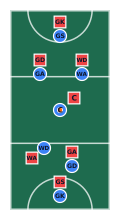
The whole netball court, goal line to goal line, with the thirds, the goal circles and the centre circle where the rules put them. Set up a centre pass, draw the leads, animate it and send the team a link.
Free forever, no signup, nothing to install.
A real court, all of it
Playmaker draws the whole netball court: 30.5 m long and 15.25 m wide, split into three equal thirds by the two transverse lines, with the 0.9 m centre circle in the middle and a 4.9 m goal circle at each end. The post stands on the middle of each goal line and the ring hangs just inside it, because that is where World Netball puts them. Every one of those numbers comes from the rule book, not from an estimate, so a lead drawn to the edge of the circle is drawn to the edge of the circle.
Most play designers draw half a pitch, and for most sports that is the right call. It is the wrong one for netball. Every position is defined by the thirds it may enter — the goal shooter never leaves the attacking third, the wing defence never sets foot in either goal circle — and the centre pass, the set play every team runs after every goal, starts with players waiting on both transverse lines and the centre in the middle of the court. Half a court would cut the centre circle in two and push the defenders off the picture before the whistle. So the whole court is drawn, attacking goal at the top and the goal you defend at the bottom, on a phone as well as a laptop.
Seven players, numbered in team-sheet order
Netball bibs carry letters, and Playmaker's players carry numbers. Rather than pretend otherwise, every netball template lists your seven in the order a team sheet does, so the numbers always mean the same thing: 1 goal shooter, 2 goal attack, 3 wing attack, 4 centre, 5 wing defence, 6 goal defence, 7 goal keeper. The opposition are drawn as squares, so it is clear at a glance who is marking whom. Tap a player to change a number if your squad uses its own.
What you can draw
- A set-up. Start from one of seven templates — the centre pass set-up, a split lead, an overload on one side, defending the opposition's centre pass, an attacking backline throw-in, a sideline throw-in in the attacking third and a defensive backline throw-in — or place all fourteen players yourself.
- The leads. Drag a player and the path becomes a timed run, so the goal attack's front cut and the wing attack's drive arrive at the transverse line in the order you want them to.
- Passes. Tap the receiver and the ball goes to where they are at that moment in the play, which is what makes a second-phase ball into the circle look right instead of going to where somebody used to stand.
- The shot. Mark the scorer and the ball animates to the ring. In netball only the goal shooter and goal attack can score, from inside the goal circle, so that is where a play should finish.
The centre pass, in one picture
A centre pass is a few seconds of movement by fourteen players at once, and it is hard to explain with a whiteboard pen. The template puts every player where the rules put them at the whistle: our centre in the circle with the ball, the opposing centre free in the centre third, and everyone else waiting in a goal third. Draw the leads off that, play it back, and your wing attack can see exactly when to go and where the space is — and your defenders can see the same play from the other side.
Netball is played in clubs and schools across Australia, New Zealand, England and the rest of the Commonwealth, and plenty of its coaches have been drawing it on a basketball diagram or a blank rectangle. This is a court that is actually a netball court.
The same goes for throw-ins. A backline throw-in under your own post and one under the opposition's post are different plays with different players involved, and on a full court both of them are drawn where they happen, with the goal circle, the ring and the 0.9 m the defender has to give the thrower all in the same picture.
Centre passes and back-lines on one sheet
The free match-day sheet prints your centre pass plays, both ways, your back-line and side-line throw-ins and your penalty set-ups on one page for the bench. Tag your plays and they land under the right heading on their own, and a QR code on the sheet plays them moving on a phone at the break.
7 netball templates, ready to draw on
Every one of these opens from the Formations button inside the designer. Load it, move the players your team does differently, and draw the runs from there.
Centre pass set-up
Formation
All fourteen players where the rules put them at the whistle: our centre in the circle with the ball, the opposing centre free in the centre third, and everyone else waiting in a goal third with a defender goal-side of them. The picture every other centre-pass play starts from.
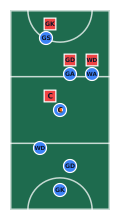
Centre pass overload right
Attack
Wing attack and goal attack stand together on the right of the transverse line, with the goal shooter drifted left at the top of the circle. Two defenders crowded into one channel get in each other's way, and if they both stay right the empty left side is there for a re-cut.
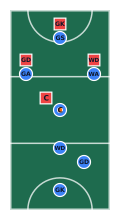
Centre pass split lead
Attack
Goal attack and wing attack start at opposite ends of the transverse line, so their defenders cannot help each other, and the wing defence sits in the middle of the defensive line as the safe back option. The centre has two first-pass targets as far apart as the court allows.
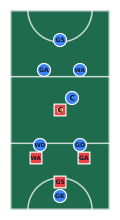
Centre pass defence: front the leads
Defence
Their centre pass. Our wing defence and goal defence stand on the ball side of the players they mark, right on the transverse line, so the straight lead to the circle edge is taken away and the first pass has to go long, wide or backwards. The goal keeper stays goal-side of the shooter.
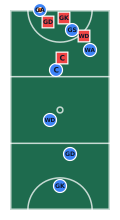
Attacking backline throw-in
Set piece
The ball has gone out over the goal line we attack. Goal attack takes it beside the post, the goal shooter holds on the far side of the ring, wing attack waits on the edge of the circle and the centre comes high as the safe pass. Their goal defence has to stand 0.9 m off the thrower.
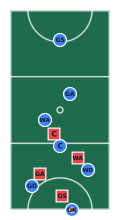
Defensive backline throw-in
Set piece
A missed shot has gone out over the goal line we defend. The goal keeper throws in, the goal defence breaks for the side line, the wing defence offers on the edge of the circle and the centre holds the transverse line, so the ball can be worked out of the defensive third in two passes.
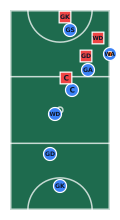
Sideline throw-in, attacking third
Set piece
Wing attack throws in from the right side line in the attacking third. Goal attack leads hard towards the thrower, the goal shooter holds in the circle for the second ball, and the centre stays back on the transverse line so there is always a pass that cannot be intercepted.
Netball play designer: common questions
Is the netball play designer free?
Yes. Drawing, animating and sharing netball plays is free and unlimited, with no signup required. A free account keeps three saved plays; the paid plan raises that limit and removes the watermark from exports.
Why does it draw the whole court and not half of it?
Because netball positions are defined by thirds. A centre pass uses all three of them at once, and a defensive backline throw-in happens at the opposite end to a shot, so half a court would leave out exactly the players a coach needs to see.
Are the court markings accurate?
Yes. The court is 30.5 m by 15.25 m with equal thirds, a 0.9 m centre circle and a 4.9 m goal circle at each end, taken from the World Netball facilities rules. The post stands on the goal line and the ring hangs just inside the court.
Can I label players GS, GA, WA and so on?
Not with letters yet. Players carry numbers, and every netball template numbers your team in team-sheet order, 1 for goal shooter through to 7 for goal keeper, so the numbers mean the same thing in every play.
Does it check the netball rules for me?
The templates are checked against them: every player starts in an area their position may enter, and the centre pass set-ups follow the centre pass rule. Once you start dragging, the canvas does not stop a player crossing a line, so offside is still the coach's call.
Can players watch a play on a phone?
Yes. Every play is a link that opens and animates on any phone, with no app and no account, so a centre pass drawn after training is in the team chat before the next session.
Coach another sport?
The same designer draws every one of them — and plenty of PE departments need two or three.
Draw your first netball play now
It opens on the netball pitch, it costs nothing, and your team can watch the play animate from a link.
Open the designerPage updated · What Playmaker is