Free rugby play designer
Rugby union, drawn on a half pitch with the 22 and the 10 in the right places. Set the lineout, draw the backline move, animate it, and send the squad a link.
Free forever, no signup, nothing to install.
Lines that are actually where the lines are
Playmaker draws a 70 m by 50 m half of a rugby union pitch with the 22 m and 10 m lines measured, the try line as the edge of the field of play, the in-goal area shaded above it and posts 5.6 m apart with the crossbar in proportion.
Those lines are not decoration in rugby — they are the rules of the game. Whether a lineout is inside your 22, whether a kick is direct to touch, where a restart has to land: every one of those is a question about a line, and a whiteboard where the 22 is "about a third of the way up" cannot answer it. Here, the 22 and the 10 land on the pitch exactly where they land on the field, so a move drawn from a scrum on the 10 m line is drawn from the 10 m line.
What you can draw
- A shape. Place all fifteen, or start from a template — a 1-3-3-1 pod distribution, a seven-man lineout, an attacking backline from a scrum, a kick-off receive — and move what you want to change.
- Lines of running. Drag a player and the path becomes a timed run, so a switch, a loop or a decoy line hits the gain line when it is meant to.
- Passes. Tap the receiver and the ball goes to where they are at that point in the move — which is what makes a miss-two or a wraparound draw itself correctly instead of as a straight line to where somebody used to stand.
- The finish. Mark the scorer and the ball animates over the line.
- The opposition. A second team, drawn as squares, for the defensive line you are attacking or the ruck you are defending.
Set piece to first phase, in one picture
A lineout move is not the lineout — it is the throw, the lift, the transfer to the scrum-half and the three seconds after that, and coaches lose players somewhere in the middle of that sentence. Draw it as one sequence and play it back: seven forwards between the 5 m and the 15 m, the hooker on the touchline, the scrum-half receiving outside the 15, the backs stacked behind, and then the move itself running off the top.
The same applies to phase play. A 1-3-3-1 is a width map — one forward in each 15 m channel, two pods of three between them — and the reason it works is that there is always a pod on both sides of the ruck. That is obvious in an animation and invisible in a list of positions.
Defence, drawn honestly
Thirteen in the line at roughly 5 m spacing, a fullback sweeping, a winger in the back field — and two players nobody volunteers for, the pillars either side of the ruck. Playmaker's rugby defensive templates put those jobs on the picture first, because pillar and post are where tries are conceded and where a diagram is worth more than a talk. Draw the opposition's shape against yours, animate two phases, and the drift or the blitz you are asking for either holds together or does not.
6 rugby templates, ready to draw on
Every one of these opens from the Formations button inside the designer. Load it, move the players your team does differently, and draw the runs from there.
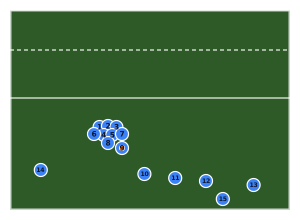
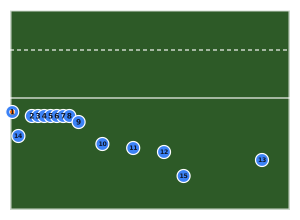
Attacking backline from a scrum
Attack
A full fifteen: eight bound into the scrum, the scrum-half at the base, and the backline fanned out to the open side roughly 8 m apart with the fly-half 10 m off the gain line. The blindside winger and fullback cover behind.
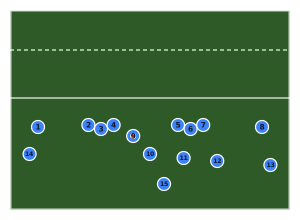
Attacking pods (1-3-3-1)
Attack
The forwards distributed across the field as one, three, three and one: a forward in each 15 m channel and two pods of three between them, with the halves, centres and back three in behind. Note the digits count players *across* the pitch, not lines of depth — 1-3-3-1 is a width map, which is exactly why it keeps a pod available on both sides of every ruck.
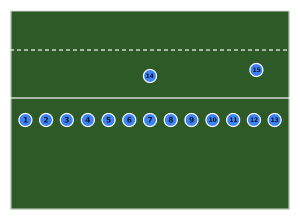
Defensive line (13 up, 2 back)
Defence
Thirteen in the front line at roughly 5 m spacing right across the pitch, with the fullback sweeping behind and the blindside winger holding the back field. The default defensive picture from a phase in the middle of the park.
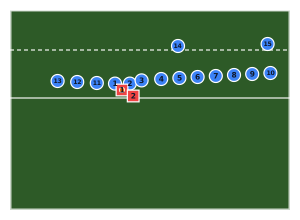
Ruck defence: pillar and post
Defence
Defending a ruck: two pillars either side of it, the post defender next out, then seven spread across the open side and three covering the blind, with the fullback and a winger sweeping. Gets the two jobs nobody volunteers for filled first.
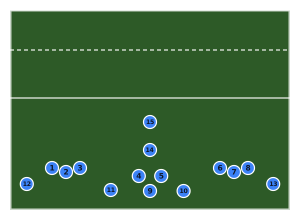
Kick-off receive
Set piece
Receiving the restart: the forwards in two pods of three with a pair in the middle, all standing at least 10 m back from halfway where the ball has to land, the halves behind them and the outside centre and fullback covering the deep kick.
Lineout (7-man)
Set piece
Seven forwards formed between the 5 m and 15 m lines with the hooker throwing from the touchline, the scrum-half receiving just outside the 15 m line and the backs stacked behind. Where the whole line stands is the bit coaches get wrong on a whiteboard, so it is drawn to the marks.
6 rugby plays to watch and remix
Famous plays and plays published by coaches, each drawn in this designer. Watch any one animate, then remix it for your team.
Browse rugby playsRugby play designer: common questions
Is the rugby play designer free?
Yes. Drawing, animating and sharing rugby moves is free and unlimited, with no signup required. A free account keeps three saved plays; the paid plan raises that limit and removes the watermark from exports.
Is this rugby union or rugby league?
The pitch, the templates and the measurements are rugby union — 22 m and 10 m lines, an in-goal area, a seven-man lineout, 1-3-3-1 pods. Much of it transfers to league, since the field markings a league coach cares most about are the same distances, but the set-piece templates are union.
Can I draw a lineout properly?
Yes. The seven-man lineout template puts the line between the 5 m and 15 m lines with the thrower on the touchline and the scrum-half receiving outside the 15 — the part coaches routinely get wrong on a whiteboard, because a whiteboard has no 5 m line. Then draw the move off the top of it.
How many players can I put on the pitch?
Fifteen a side, and the templates use all fifteen where the picture needs them. Players are numbered automatically so a printed diagram is readable without a key.
Does it animate phases, or just one movement?
One continuous sequence of runs and passes with a finish — enough for a set-piece strike move or a two-phase pattern. It is a play designer rather than a full match simulator: if you want three phases, most coaches draw three plays and send all three.
Can players watch it on a phone?
Yes. Every play is a link that opens and animates on any phone, with no app and no account, so a move drawn on Tuesday night is in the squad chat two minutes later.
Coach another sport?
The same designer draws every one of them — and plenty of PE departments need two or three.
Draw your first rugby play now
It opens on the rugby pitch, it costs nothing, and your team can watch the play animate from a link.
Open the designerPage updated · What Playmaker is