Free baseball play designer
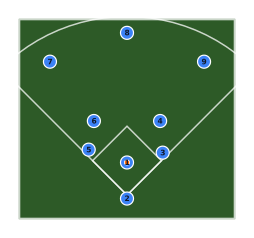
A whole field, drawn to 90 ft bases and a 60 ft 6 in mound. Set the alignment, draw who covers what, animate the throw, and send your infield the link.
Free forever, no signup, nothing to install.
A whole diamond, not half a field
Baseball is the one sport here drawn as a complete field rather than an attacking half, because a baseball fielding play uses all of it. Home plate sits inside the frame with the bases 90 ft apart on the diagonal, the mound at 60 ft 6 in, the foul lines opening at 45° either side, a 330 ft fence with the warning track in front of it, and the batter's, catcher's and on-deck boxes drawn in.
Real distances are the point of a defensive diagram. "Middle infielders at double-play depth" means about 140 ft rather than the 150 they normally play, and the whole trade — a step less to the bag, a step less range in the hole — is a distance argument. Drawn to scale, the trade is visible. Drawn freehand, it is a sentence.
What you can draw
- An alignment. Place the nine, or start from a template: standard, double-play depth, infield in, no-doubles, corners in for the bunt, holding the runner, a legal shade.
- Movement. Drag a fielder and the path becomes their timed route — the second baseman breaking to cover first on a bunt, the shortstop drifting to the bag, an outfielder going to back up the throw.
- Throws. Tap the receiver and the ball travels to where that fielder is standing at that moment, which is exactly how a cutoff or a relay should be drawn: the throw goes to where the cutoff man will be, not where he started.
- The play at the plate. Mark the last throw and the ball animates home.
- Runners. A second team, drawn as squares, so a runner on first and the batter are on the same picture as the defence that is reacting to them.
Coverage, which is what actually gets missed
Nobody misplays a ground ball because they did not know where the ball was going. Baseball games are lost because the bag was uncovered, the cutoff man was in the wrong lane, or two outfielders went for the same ball and nobody backed up the throw.
That is a coverage diagram, and it is a diagram of movement — which is what animation is for. Draw the bunt defence: corners charging, pitcher breaking to the plate side, second baseman to first, shortstop to second, outfield in behind it because nobody is left to back the infield up. Press play and the hole that opens up while everyone is moving is on the screen. Then print it for the dugout.
Seven alignments to start from
Every defensive template ships as a change from the standard alignment, which is how coaches actually teach it: this is where we stand, and here is what moves when there is a runner on third in a one-run game. Infield in, no-doubles late with a lead, holding the runner at first, double-play depth, and a shade to the pull side that keeps two infielders on each side of second base as the rules have required since 2023.
Load one, move the two players your team does differently, name it, and it is yours.
7 baseball templates, ready to draw on
Every one of these opens from the Formations button inside the designer. Load it, move the players your team does differently, and draw the runs from there.
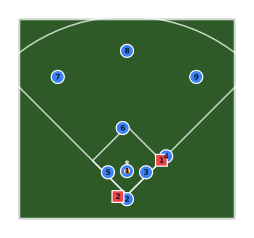
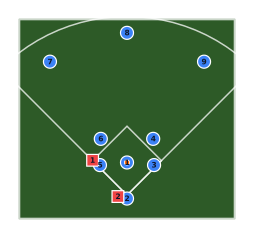
Bunt defence (corners in)
Defence
Both corner infielders charge on contact, the pitcher breaks towards the plate, the second baseman covers first and the shortstop takes second. The outfield comes in behind it because nobody is left to back the infield up.
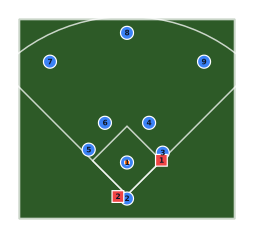
Double-play depth
Defence
Runner on first, less than two out: the second baseman and shortstop move in to about 140 ft and shade towards the bag so either can take the feed and turn two. Trades range in the hole for a step less to the base.
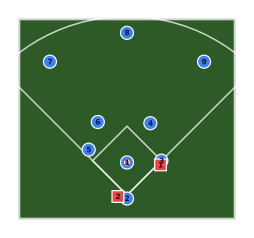
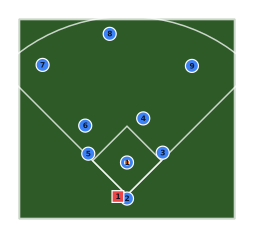
Holding the runner at first
Defence
First baseman on the bag for the throw over, second baseman leaning towards the bag to take the steal, shortstop a step across. The hole on the right side is the price of holding the runner close.
Infield in
Defence
Runner on third in a one-run game: all four infielders move onto the grass to cut the run off at the plate. The ground ball that would have been an easy out is now a play at home.
Infield shaded to the pull side
Defence
A legal shade against a right-handed pull hitter: third base guards the line, the shortstop slides towards the hole and the second baseman moves towards the bag — but two infielders stay on each side of second, as the rules have required since 2023. The outfield rotates with them.
No-doubles defence
Defence
Late innings, protecting a lead: the corners guard the lines and the outfielders play deep and towards the gaps. Concedes the single to take the extra-base hit away.
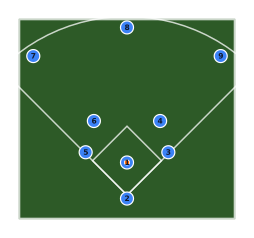
Standard fielding alignment
Defence
The nine where they stand with nobody on and nothing to defend against: middle infielders about 150 ft out either side of second, corners in front of their bags, and the outfield at 285-300 ft. Everything else on this list is a change from here.
6 baseball plays to watch and remix
Famous plays and plays published by coaches, each drawn in this designer. Watch any one animate, then remix it for your team.
Browse baseball playsBaseball play designer: common questions
Is the baseball play designer free?
Yes. Drawing, animating and sharing plays is free and unlimited, and no account is needed to start. A free account keeps three saved plays; the paid plan raises that limit and removes the watermark from exports.
Is the field drawn to real dimensions?
Yes — 90 ft between bases, a mound 60 ft 6 in from the plate, foul lines at 45° and a 330 ft fence with a warning track. The frame is 400 ft by 370 ft, which holds the fence plus foul territory, so positioning drawn at 150 ft looks like 150 ft.
Can I draw cutoffs and relays?
Yes, and this is where the animation earns its keep. Each throw travels to where the receiving fielder is standing at that point in the play, so a relay drawn as three throws plays back with the cutoff man moving into the lane rather than waiting on the spot.
Can I show base runners?
Yes. Runners and the batter go on as the second team, drawn as squares so they are never confused with your fielders, and they can be given paths like anyone else.
Which templates come with it?
Seven defensive alignments: standard fielding, double-play depth, infield in, no-doubles, bunt defence with the corners in, holding the runner at first, and a legal infield shade to the pull side.
Is it useful for softball too?
Mostly. The coverage and cutoff principles are identical and the templates transfer, but the diamond is drawn to baseball distances — 90 ft bases and a 60 ft 6 in mound — so positioning is not to scale for a 60 ft softball infield.
Coach another sport?
The same designer draws every one of them — and plenty of PE departments need two or three.
Draw your first baseball play now
It opens on the baseball pitch, it costs nothing, and your team can watch the play animate from a link.
Open the designerPage updated · What Playmaker is