Free volleyball play designer
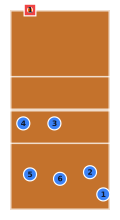
The whole volleyball court, end line to end line, with the net across the middle and an attack line 3 m either side of it. Set up your serve receive, draw the transition, animate it and send the team a link.
Free forever, no signup, nothing to install.
The whole court, with the net in the middle
Playmaker draws the whole volleyball court: 18 m long and 9 m wide, split into two 9 m halves by the net over the centre line, with an attack line 3 m back from the net on each side. Those are the FIVB's own numbers, from the Official Volleyball Rules (rules 1.1, 1.3.3 and 1.3.4), and every line is drawn inside the court it bounds, as the rules say it is. The antenna on each sideline marks the ends of the net, so a ball drawn over the net is drawn over the part of it that counts.
Most play designers draw half a field, and for most sports that is the right call. It is the wrong one for volleyball. A rally crosses the net every few seconds, a serve-receive formation only makes sense against where the serve is coming from, and a block is two players on opposite sides of the same metre of net. So the whole court is drawn, the court you attack at the top and your own court at the bottom, on a phone as well as a laptop. Your six stand in the bottom half, facing the net, with zone 4 on the left and zone 2 on the right, which is how every rotation diagram a volleyball player has ever seen is drawn.
Six players, labelled the way volleyball coaches write them
Tap any player and give them a label in place of a number. The quick picks are the ones a volleyball whiteboard already uses: S for the setter, OH for an outside hitter, MB for a middle blocker, OPP for the opposite, L for the libero and DS for a defensive specialist. Every volleyball template numbers your players by zone, 1 to 6, so the numbers on the picture are the zones the rotation is called by. The opposition are drawn as squares, so it is clear at a glance which side of the net everyone is on.
What you can draw
- Serve receive. Who passes, where the setter hides until the serve is struck, and the run they make to the net once it is.
- Base defence. A double block on their outside hitter and the back row on the edges of the court, or a rotation defence that brings the right back up for the tip.
- Hitter coverage. The cup of players closing in behind your attacker, so a ball blocked straight down is still yours.
- Quick attacks. Drag the middle into a quick, the outside into a high ball and the opposite to the right, and the paths become timed runs that arrive in the order you want.
- Passes and sets. Tap the receiver and the ball goes to where they are at that moment of the play, which is what makes a pass, a set and an attack read as one rally.
Start from a template
Six volleyball templates open straight onto the court: serve receive with the setter in 1, serve receive with the setter in 4, the serving team set-up, perimeter defence, rotation defence and hitter coverage. The serve-receive and serving templates are checked against the overlap rule, so every player starts in a spot that is legal at the moment of serve. Open one, drag anybody, and draw from there.
A rotation maker for all six rotations
The free volleyball rotation maker draws all six rotations of a 5-1, a 6-2 or a 4-2, with or without a libero. Every serve-receive formation it draws is legal under the overlap rule, and each one animates to the base positions your players move to once the serve is away. Type your players' names, print the six courts on one page for the bench, or send a link to the team. The names stay in your browser; nothing is sent to us unless you save it to your account.
Fair playing time, set by set
For who plays which set rather than who stands where, the volleyball playing time rotation gives every player on your roster the same number of sets, give or take one, and nobody sits two sets in a row. It prints on one page and needs no account.
There is no volleyball drill library yet. Until there is, draw your own drills on the court and keep them in your playbook with the plays they practise.
6 volleyball templates, ready to draw on
Every one of these opens from the Formations button inside the designer. Load it, move the players your team does differently, and draw the runs from there.
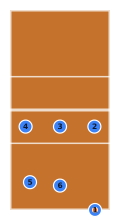
Serving team set-up
Formation
Our serve, setter serving from behind the end line: the front three at the net ready to block and the back two in front of the server, every player in their rotation order so the overlap rule holds.
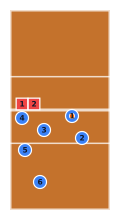
Hitter coverage
Attack
Our outside hitter attacks from the left against a double block, and the other five close in behind them in a cup: the middle and libero tight, the back-row hitter deep, so a ball blocked straight down is still ours.
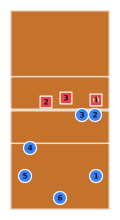
Perimeter defence
Defence
A two-player block on their outside hitter, the left-front player off the net for the sharp angle, and the back row on the edges of the court: right back on the line, left back cross-court and the middle back deep.
Rotation defence
Defence
The same double block on their outside hitter, but the back row rotates towards the attack: the right back comes up behind the block for the tip, the middle back slides to the line and the left back covers the deep cross-court ball.
Serve receive, setter in 1
Set piece
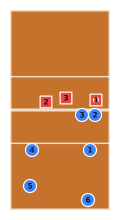
Three-passer serve receive with the setter in zone 1: both outside hitters and the libero share the court, the setter tucks in behind the right-side passer, and the opposite and middle wait at the net. Legal under the overlap rule at the moment of serve.
Serve receive, setter in 4
Set piece
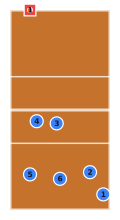
The setter starts front left at the net and slides right to set, while the outside hitters and libero take the serve and the opposite hides deep behind the right-side passer. Legal under the overlap rule at the moment of serve.
Volleyball play designer: common questions
Is the volleyball play designer free?
Yes. Drawing, animating and sharing volleyball plays is free and unlimited, with no signup required. A free account keeps three saved plays; the paid plan raises that limit and removes the watermark from exports.
Why does it draw the whole court and not half of it?
Because a volleyball rally crosses the net. Serve receive is read against where the serve is coming from, a block is two players on either side of the net, and an attack lands in the other court, so half a court would leave out the half every play is aimed at.
Are the court markings accurate?
Yes. The court is 18 m by 9 m with the net over the centre line and an attack line 3 m from it on each side, taken from the FIVB Official Volleyball Rules. The antennae stand on the sidelines at the net, where the rules put them.
Can I label players S, OH, MB and L?
Yes. Tap any player and pick a label, or type up to three letters of your own in place of their number. The quick picks are S, OH, MB, OPP, L and DS.
Does it check the overlap rule for me?
The templates and the rotation maker are checked: every serve-receive formation they draw is legal at the moment of serve, front row ahead of back row and left to right in order. Once you start dragging on the canvas, nothing stops a player crossing a line, so an overlap in a play you draw yourself is still the coach's call.
Can players watch a play on a phone?
Yes. Every play is a link that opens and animates on any phone, with no app and no account, so a serve-receive pattern drawn after training is in the team chat before the next session.
Can the libero serve?
Not under FIVB rules, which keep the libero to the back row and never let them serve. Some youth, school and college rule books allow the libero to serve in one rotation, so check the rules your federation or league plays to before you build a line-up around it.
Coach another sport?
The same designer draws every one of them — and plenty of PE departments need two or three.
Draw your first volleyball play now
It opens on the volleyball pitch, it costs nothing, and your team can watch the play animate from a link.
Open the designerPage updated · What Playmaker is