Free football play designer
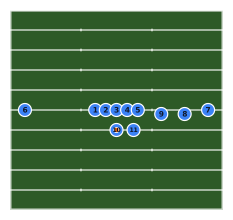
A gridiron drawn to the yard, with hash marks on the thirds and the end zone above the goal line. Set the formation, draw the routes, animate the snap, and send the link.
Free forever, no signup, nothing to install.
A field measured in yards, because football is
Playmaker draws the fifty yards from a goal line back to the 50, at the real 160 ft of width — a yard line every five yards, hash marks 53 ft 4 in in from each sideline, the numbers twelve yards in and reading up the sideline the way they are painted, and the ten-yard end zone shaded above the goal line.
Fifty yards rather than a hundred is the one deliberate decision in that list, and it is worth stating plainly. A whole field with both end zones is 120 yards long and 53⅓ wide, which is a picture two and a quarter times taller than it is broad; fitted to a screen it leaves a play happening in a smudge. A route tree lives inside twenty-five yards of the line of scrimmage. So the snap goes on the 25, the routes run into the red zone, and the goal line and the end zone are in the frame doing work instead of off it.
The hash marks matter more than they look. At 53 ft 4 in they cut the field into thirds, so where the ball is spotted is visible rather than asserted, and the difference between a formation's strong side on the left hash and the same formation in the middle of the field is something a coach can point at.
Routes that keep their cuts
Every other sport here has its movement smoothed, because a run recorded by dragging a finger is a noisy line and a player changing direction does it on a curve. A football route is the exception, and it is the whole point of the sport's diagrams: a slant, a post and an out are the same two straight legs with a different angle between them. The cut is the information.
So on the gridiron a dragged route is drawn as the route that was dragged. Five yards and break in, five yards and break out, twelve and up — the corner survives, at the yard it was drawn on, in the editor and in every export.
What you can draw
- A formation. Place all eleven, or start from a template: I formation, shotgun trips, five wide, singleback, goal line heavy, or a cover two shell for the defence.
- Routes. Drag a receiver and the path becomes their timed release, so a three-step slant and a fourteen-yard comeback arrive when they are supposed to rather than at the same time.
- The handoff and the throw. Tap the receiver and the football travels to where that player is at that point in the play, which is what makes a screen or a play-action handoff draw itself correctly instead of as a line to where somebody used to stand.
- The touchdown. Mark the scorer and the ball animates into the end zone.
- The defence. A second team, drawn as squares, for the front you are blocking or the coverage you are attacking.
Flag football, at seven a side and five
Flag is where most young football is actually played, and it is not eleven-a-side with fewer players — it is a different game with a centre, a quarterback and everybody else eligible. The templates say so: 7v7 trips and a 7v7 bunch, 5v5 spread and a 5v5 stack. The stack is the one worth loading first, because two receivers one behind the other is a problem no defender can line up over, and it is far easier to see than to explain.
Flag fields are narrower than a gridiron, but a yard is a yard, so a route drawn here is the route your team runs. Set the depth you actually coach, animate it, and send it. There is a whole page for it — the flag football play designer — because flag is not eleven-a-side with players removed: the line to gain is fixed, there are no-run zones, and in most rule sets the quarterback cannot run.
The wristband and the call sheet, free
Football is the one sport in this market where the printout is the product. Twenty numbered calls in the vinyl window on a quarterback's wrist coach, and the coach's own situational sheet on one page.
The football wristband maker does both from a typed play list, free and with no account — the insert sizes were measured off the band manufacturers' own printable templates, and the flag call sheet is built from the flag rulebook rather than from the tackle sheet with sections deleted. Every other football tool we can find charges for that, or asks you to register first: the free football play designers compared page has the figures, dated, with the pages they were read from.
10 American football templates, ready to draw on
Every one of these opens from the Formations button inside the designer. Load it, move the players your team does differently, and draw the runs from there.
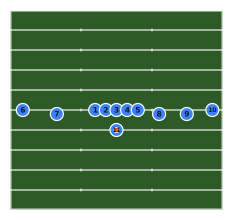
Five wide
Formation
Empty backfield, five eligible receivers spread from sideline to sideline and nobody left to block but the five up front. Every defender is accounted for before the snap, which is the whole argument for it and the whole risk of it.
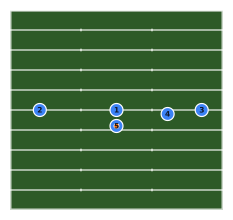
Flag 5v5 spread
Formation
Five a side: a centre to snap it, a quarterback, and three receivers spread as wide as the field allows. With no blocking and no back, every play is a route combination and every defender is in coverage.
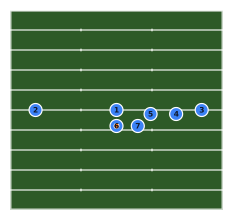
Flag 7v7 trips right
Formation
Seven a side, no line to speak of: a centre, a quarterback, a back and four eligible receivers with three of them stacked right. Flag is played on a narrower field than this one, but a yard is a yard, so the six-yard gaps between the receivers are what transfers.
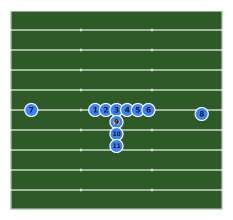
I formation
Formation
The base two-back set: tight end and flanker to the strong side, split end isolated left, and the fullback and running back stacked directly behind the quarterback. Drawn on the 25 so a route tree has the full 25 yards to the goal line.
Shotgun trips right
Formation
Three receivers stacked to the right with the back beside a shotgun quarterback, leaving the split end alone on the left. The formation that makes a defence declare where its extra defender is going before the snap.
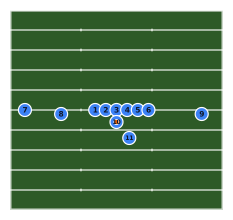
Singleback spread
Formation
One back, one tight end and three receivers — the most common set in the sport, because it can run and throw from the same picture. Quarterback under centre, back offset behind him, slot receiver to the weak side.
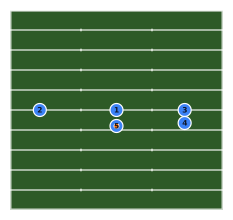
Flag 5v5 stack right
Attack
Two receivers stacked one behind the other on the right, so a defender cannot line up over both of them. Whichever way the front man releases, the back man goes the other, and the coverage has to sort it out on the run.
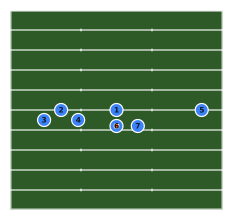
Flag 7v7 bunch left
Attack
Three receivers bunched in a triangle to the left, which is how a seven-a-side team beats man coverage without a blocker in sight: the defenders have to run through each other to stay attached.
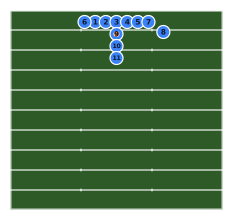
Goal line heavy
Attack
Second and goal from the three: two tight ends, a wing, and three players stacked in the backfield. Nine blockers against a defence with nowhere left to retreat to — the one situation where the end zone is the whole diagram.
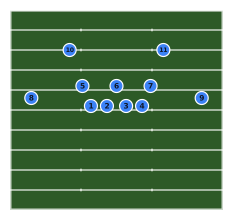
Cover two shell
Defence
Four down, three linebackers and two safeties splitting the deep half of the field between them, with both corners squatting on the flat. The coverage that gives up the seam and takes away everything outside it.
8 American football plays to watch and remix
Famous plays and plays published by coaches, each drawn in this designer. Watch any one animate, then remix it for your team.
Browse American football playsAmerican football play designer: common questions
Is the football play designer free?
Yes. Drawing, animating and sharing football plays is free and unlimited, with no signup required. A free account keeps three saved plays; the paid plan raises that limit and removes the watermark from exports.
Is this American football or soccer?
American football — the gridiron. Yard lines, hash marks, an end zone and eleven a side. Soccer is a separate sport in the designer with its own pitch, so the two never get drawn on each other's field.
Why does the field only show fifty yards?
Because a play happens in about thirty of them. A full 120-yard field is more than twice as tall as it is wide, which shrinks the players to dots. Fifty yards from the goal line to the 50 keeps the end zone in the picture and still leaves a route tree all the room it needs.
Can I draw flag football plays?
Yes. There are 7v7 and 5v5 templates — trips, bunch, spread and stack — and you can place any number of players yourself. The field is the same gridiron, drawn to the same yard, so depths transfer directly to a flag field.
Do the routes keep their sharp cuts?
Yes, and only in football. Movement in the other sports is smoothed into a curve; a gridiron route is drawn exactly as it was dragged, so a break at five yards is a break at five yards rather than a gentle bend through it.
Can I print football plays on a wristband?
Yes, and it costs nothing. The free football wristband maker prints your play calls as a numbered insert sized to real wrist-coach windows, plus a one-page situational call sheet, with no account and no signup. If you want the drawing rather than the call on the card, the play wristband maker prints one diagram per insert instead.
Can my players watch it on a phone?
Yes. Every play is a link that opens and animates on any phone, with no app and no account, so a play drawn on Tuesday night is in the team chat two minutes later.
Coach another sport?
The same designer draws every one of them — and plenty of PE departments need two or three.
Draw your first American football play now
It opens on the American football pitch, it costs nothing, and your team can watch the play animate from a link.
Open the designerPage updated · What Playmaker is