Football formations, every set on one page
Each set is drawn to scale on a real gridiron, with a line on when to use it and a page on how it works. Compare them here, then open the one you want and draw the routes and blocks your team runs from it.
Free, no account, nothing to install.
11-man offensive formations
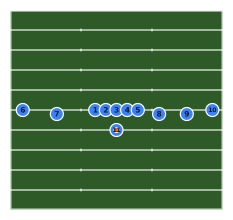
Five wide
Formation · 11 players
When the defense is not blitzing and you want the ball out of the quarterback's hand quickly.
Read the setup
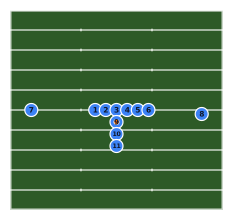
I formation
Formation · 11 players
When you want to run downhill behind a lead blocker, and keep the defense guessing which side the play is going.
Read the setup
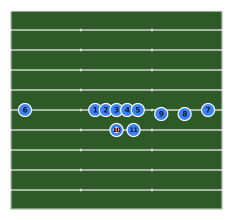
Shotgun trips right
Formation · 11 players
When you want the defense to show where its extra defender is going before the snap.
Read the setup
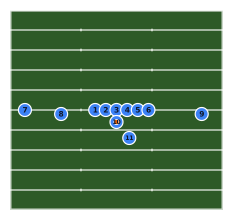
Singleback spread
Formation · 11 players
When you want to run and throw from the same picture, with a tight end who can block or go out on a route.
Read the setup
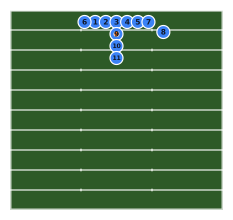
Goal line heavy
Attack · 11 players
Second and goal inside the five, when you need a yard or two and want every blocker you can fit.
Read the setup
How the offensive formations compare
Five linemen and a quarterback are in every one, so the other five players are the difference: who is in the backfield, who is on the end of the line and who is split out wide. Every set is a starting point, and the routes and the blocking are yours to draw.
| Formation | Backs | Tight ends | Receivers | Strength | Weakness |
|---|---|---|---|---|---|
| Five wide | Backs: None | Tight ends: None | Receivers: Five | Strength: Every defender is counted before the snap, with no free man | Weakness: Five blockers, so a six-man rush has a free run at the passer |
| I formation | Backs: Two: a fullback and a tailback | Tight ends: One | Receivers: Two | Strength: A lead blocker, and a back who can hit the hole on either side | Weakness: Only two receivers, so the defense can crowd the box |
| Shotgun trips right | Backs: One, beside the quarterback | Tight ends: None, or one as the inside trips man | Receivers: Four | Strength: Makes the defense declare its extra defender before the snap | Weakness: Tells the defense where the strength is, so it can roll coverage to the trips |
| Singleback spread | Backs: One | Tight ends: One | Receivers: Three | Strength: Runs and passes equally well from the same look | Weakness: One back leaves less help in pass protection |
| Goal line heavy | Backs: Two, plus a wing back | Tight ends: Two | Receivers: None | Strength: Nine blockers for the yard or two you need | Weakness: Nobody spread wide, so a pass has to come off play action |
11-man defensive formations
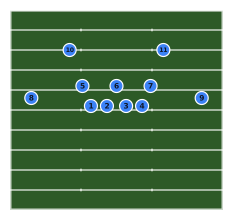
Flag football sets, seven and five a side
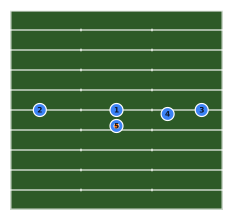
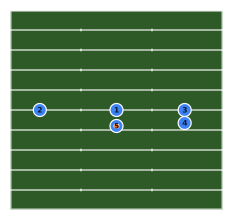
Flag is a different game from eleven-man football: a center, a quarterback and everybody else eligible, with no blocking. These sets are drawn for it, not cut down from eleven. For the rules that shape them, from no-run zones to the rush, see the flag football play designer.
Seven a side flag (7v7)
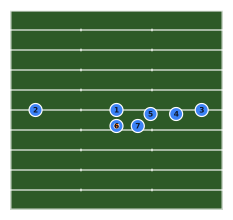
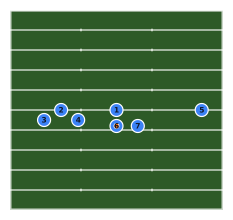
Five a side flag (5v5)
What a formation tells you, and what it does not
A football formation is where the eleven players stand before the snap. On offense five of them are always the linemen and one is the quarterback, so a formation is really a decision about the other five: how many are backs behind the quarterback, how many are tight ends on the end of the line, and how many are receivers split out wide. Coaches count that with two digits, running backs then tight ends, so the singleback spread is eleven personnel (one back, one tight end) and the I formation is twenty-one.
A formation is where a play starts, not the play. The same I formation runs a lead play, a toss and a play-action pass, and that is the point of it: the defense cannot tell which from the alignment. That is why each set here is a picture to start from rather than a finished call. Open it, then draw the routes and the blocks, and press play to watch it run.
Picking a set for your players
Start from who you have. A big back and a fullback who likes contact make the I formation worth running; a tight end who can catch makes the singleback spread hard to defend; three quick receivers make trips a problem every snap. Five wide asks the most of your line and your quarterback, so it is the last set to install, not the first.
For young players the game decides first. Most children start in flag, at five or seven a side, where there is no blocking and everybody but the center and the quarterback can catch the ball. Those sets are drawn on this page too, and the flag football play designer has the rules that shape them: the no-run zones, the rush and the line to gain.
Football formations: common questions
What is the most common football formation?
At every level from high school up, one back and one tight end, with three receivers, is the group you will see most often. Teams line it up from under center as a singleback set or from the shotgun, because the same eleven players can run the ball and throw it without the defense knowing which is coming.
What is the difference between an offensive and a defensive formation?
An offensive formation places the eleven players who have the ball: the line, the quarterback, the backs and the receivers. A defensive formation places the eleven trying to stop them: the linemen, the linebackers and the defensive backs. The cover two shell on this page is a defense, with two safeties splitting the deep half of the field between them.
Which football formation is easiest to teach?
The I formation. Every player has a simple job, the backs line up one behind the other, and the plays a young team learns first, the dive, the lead and the toss, all come from it. It is a good base before you ask a team to spread out and read a defense.
Can I change a formation after I open it?
Yes. Every formation opens on the canvas as a starting picture. Drag any player to a new spot, draw their routes and blocks, press play to watch it move, and send your team the link. It is free and you do not need an account.
Draw your own formation
Open a football field, place your players, draw their routes and press play. Free, and you do not need an account.
Open a football fieldPage updated · Football play designer · All football templates