Seven a side, three of them stacked right
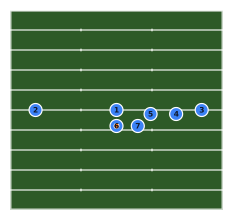
American football · Formation · 7 of your players
Flag 7v7 trips right creates nothing for a blocker and everything for a route runner. With no offensive line, a formation exists only to make three defenders cover three receivers badly.
Opens on a american football pitch with the shape already drawn. Free, no signup.
Seven players, and only one of them snaps it
There is a centre on the ball, a quarterback four yards behind him, and a running back five yards to the quarterback's right. The other four are eligible receivers, and three of them are right: an outside man near the sideline, then two more a yard off the line, laddered six yards apart, the innermost of them sitting exactly on the right hash. The fourth receiver is alone on the left.
There is no offensive line to speak of. Seven a side means the centre releases after the snap and the quarterback has whatever the rush rules give him, which changes what a formation is for entirely. In eleven-a-side football an alignment creates blocking angles. Here it only creates coverage problems.
Read the gaps, not the sidelines
The pitch under this drawing is a full gridiron, fifty-three yards from sideline to sideline. A flag field is usually twenty-five or thirty. So the numbers to copy off the picture are the gaps between players, not the distances to the paint: six yards between each of the trips is the spacing that travels to any field, and the outside receiver's split shrinks to whatever your sideline gives him.
Six yards is the useful number because it is far enough that one defender cannot cover two of them and close enough that all three are inside the same throw. Draw them three yards apart and the routes run into each other. Draw them ten apart and it stops being trips and becomes three isolated receivers.
Building plays from it
- Three defenders, three receivers, one rule. Most seven-a-side defences play man. Draw the three routes at three different depths — flat, five yards, deep — and the coverage has to run through itself.
- Use the back. He and the split end are the only players on the left half of the field. Send him out of the backfield to the empty side and count who is left to take him.
- Then take the trips away. Redraw the same seven with two receivers a side and see how much easier the defence's job became. That comparison sells the formation to a squad better than any explanation.
Open it in the designer, set the width of the field you actually play on, then draw the three routes you can get thrown inside four seconds.
Also known as
- flag football
- seven a side
- trips
- 7v7
- youth
Shapes to look at next
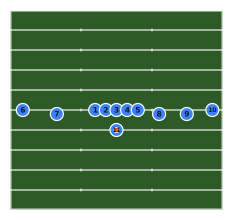
Five wide
Formation · 11 players
Empty backfield, five eligible receivers spread from sideline to sideline and nobody left to block but the five up front. Every defender is accounted for before the snap, which is the whole argument for it and the whole risk of it.
Read the setup
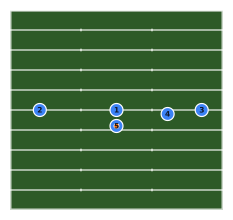
Flag 5v5 spread
Formation · 5 players
Five a side: a centre to snap it, a quarterback, and three receivers spread as wide as the field allows. With no blocking and no back, every play is a route combination and every defender is in coverage.
Read the setup
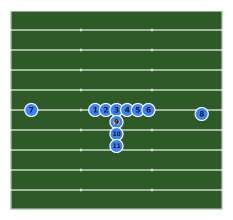
I formation
Formation · 11 players
The base two-back set: tight end and flanker to the strong side, split end isolated left, and the fullback and running back stacked directly behind the quarterback. Drawn on the 25 so a route tree has the full 25 yards to the goal line.
Read the setup
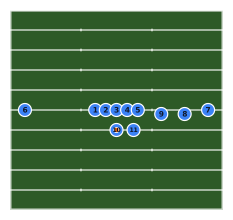
Shotgun trips right
Formation · 11 players
Three receivers stacked to the right with the back beside a shotgun quarterback, leaving the split end alone on the left. The formation that makes a defence declare where its extra defender is going before the snap.
Read the setup
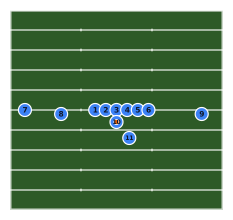
Singleback spread
Formation · 11 players
One back, one tight end and three receivers — the most common set in the sport, because it can run and throw from the same picture. Quarterback under centre, back offset behind him, slot receiver to the weak side.
Read the setup
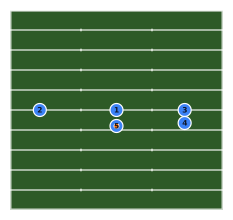
Flag 5v5 stack right
Attack · 5 players
Two receivers stacked one behind the other on the right, so a defender cannot line up over both of them. Whichever way the front man releases, the back man goes the other, and the coverage has to sort it out on the run.
Read the setup
Put the Flag 7v7 trips right on a pitch
It opens with the shape already drawn. Move the players your team does differently, drag the runs, and send your squad a link that animates.
Open in PlaymakerPage updated · American football play designer · All templates