Free youth soccer play designer, for 7v7 and 9v9
Six small-sided shapes to start from, a play that animates for the parent who reads it on a phone, and copy written for the ages that actually play 7v7 and 9v9. Draw it after training, in the team chat that night.
Free forever, no signup, nothing to install.
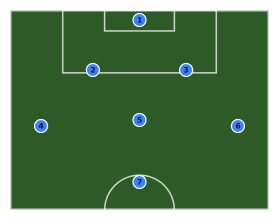
Most youth soccer is not eleven a side
Almost every formation you can find online is for eleven players, and almost every child under thirteen plays with fewer. The formats are close to the same everywhere:
- 7v7 at under-9 and under-10. US Youth Soccer and the English FA both put these two ages on a seven-a-side pitch, roughly 50 to 60 metres long and 30 to 40 wide, with a goalkeeper and six outfield players. Canada's development pathway does the same.
- 9v9 at under-11 and under-12. A bigger pitch, roughly 70 to 80 metres by 40 to 50, a bigger goal, and eight outfield players. It is the bridge format: enough players for real lines, few enough that everybody still touches the ball.
- 11v11 from under-13. The full game, and the shapes on the soccer play designer page.
Australia's MiniRoos usually moves each step a year earlier, and plenty of leagues have their own rules, so check yours. What does not change is the problem: a 4-3-3 with four players deleted is not a 7v7 formation, and drawing one on a whiteboard teaches your team a shape it will never play.
Why the shapes are different at each age
A good small-sided shape gives every child a lane of their own and a job they can see. Two things decide which shape suits your team.
At 7v7 the question is how many stay back. With six outfield players you can afford two defenders or three, not both. Two at the back (the 2-3-1) gives you a midfield three across the whole width and is the shape most clubs start under-9s in, because every player has somebody beside them and nobody is ever the last defender alone. Three at the back (the 3-2-1) is the safer picture for a team that keeps conceding on the counter, and it costs you width in midfield. The 2-1-2-1 is a diamond, and it is the one that teaches triangles: the holding player in the middle always has a pass to either side.
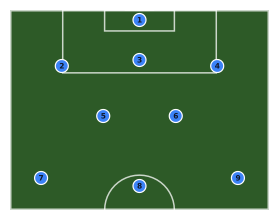
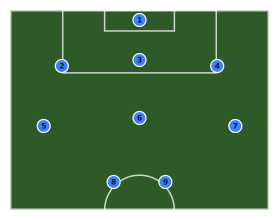
At 9v9 the question is where the extra two go. Eight outfield players is enough for three lines, and the three common shapes differ in which line gets the numbers. The 3-2-3 puts them up front, with two wingers on the touchlines: it is the 4-3-3 most clubs grow their players into, made small. The 3-3-2 is the balanced one, a player in every lane of midfield and a strike partnership. The 2-3-2-1 puts them in the middle and asks two centre backs to be comfortable on the ball, which is the right demand of an under-12 and the wrong one of an under-10.
The shape is half of it. The other half is rotating children through it, which is why none of these is a shape to pick once and keep. A defender at nine who never plays further forward is a defender at thirteen who cannot.
The build-out line is why the back line matters early
US Youth Soccer's 7v7 and 9v9 games have a build-out line, and the FA's mini-soccer has a retreat line. Both do the same thing: when your goalkeeper has the ball, the opposition has to drop back and let you play it out. It is there to make young teams pass out from the back instead of kicking it long, and it is why the back line of every small-sided shape on this page is drawn wide, either side of the goal, rather than tucked in front of the keeper. A centre back standing beside the post is a pass. A centre back standing in front of the keeper is a defender who has to be passed around.
Draw the line where your league puts it, then animate the first two passes out of the keeper's hands. That is the diagram a nine-year-old can follow on a Thursday and do on a Saturday.
On the pitch you are drawing
Playmaker has one soccer pitch, the attacking half of a full-size eleven-a-side pitch, and that is what these templates are drawn on. We would rather say so than pretend: the penalty area and the centre circle on the drawing are the eleven-a-side ones, bigger than the markings on a 7v7 or 9v9 pitch.
So the six small-sided shapes are drawn in proportion rather than to the metre. The keeper is on the goal line, the back line about a third of the way up the half, the front player close to halfway, spread across the width the way the shape spreads across yours. What transfers is the shape: who is beside whom, which lane each player owns, and how far each line is from the next as a share of the pitch. A small-sided pitch drawn to its own measurements is the next thing on our list.
What is on this page's shelf
Six starting shapes, three at seven a side and three at nine:
- 7v7 2-3-1: two centre backs, a midfield three and a striker. The standard.
- 7v7 3-2-1: three at the back for a team that leaks goals on the break.
- 7v7 2-1-2-1: the diamond, for teaching triangles and an early first pass.
- 9v9 3-2-3: a front three with wingers on the touchlines.
- 9v9 3-3-2: a lane-by-lane midfield and two strikers.
- 9v9 2-3-2-1: numbers in the middle, for an older team that keeps the ball.
Each opens from the Formations button inside the designer with the right number of players already on the pitch. Move the two or three your team does differently, then drag the runs and press play.
The rest of a small-sided season
Seven-a-side is twelve children on a squad and seven on the pitch, so playing time is the argument you have every Saturday. The free youth soccer rotation maker does 7v7 and 9v9: type the squad and every player gets within one quarter of everyone else, on one printed page.
For the week in between there are animated soccer drills that drop straight into a timed practice plan, and a position card prints each player their own job with their run picked out, which is the format a nine-year-old actually reads.
6 youth soccer templates, ready to draw on
Every one of these opens from the Formations button inside the designer. Load it, move the players your team does differently, and draw the runs from there.
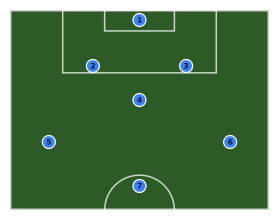
7v7 2-1-2-1
Formation
Seven a side as a diamond: two centre backs, one holding midfielder, two wide players and a striker. It teaches the triangles every older shape is made of, and asks the holding player to read the game early.
7v7 2-3-1
Formation
Seven a side: a keeper, two centre backs, a midfield three across the pitch and one striker. The most common 7v7 shape, because every player has a clear lane and nobody is left alone at the back.
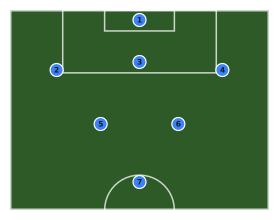
7v7 3-2-1
Formation
Seven a side with three at the back, two central midfielders and a striker. The safer shape for a young team that concedes on the counter: a spare defender behind the ball, at the cost of width further up.
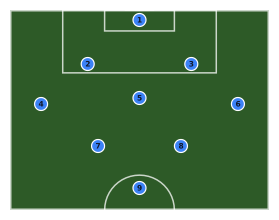
9v9 2-3-2-1
Formation
Nine a side: two centre backs, a midfield three, two attacking midfielders and a lone striker. The possession 9v9 shape: numbers in the middle of the pitch, and a back two that has to be comfortable on the ball.
9v9 3-2-3
Formation
Nine a side: a back three, two central midfielders and a front three with wingers on the touchlines. The attacking 9v9 shape, and the closest small-sided picture of the 4-3-3 most clubs grow their players into.
9v9 3-3-2
Formation
Nine a side: a back three, a midfield three across the pitch and two strikers. The balanced 9v9 shape, with a player in every lane of midfield and a strike partnership that learns to split and combine.
6 youth soccer drills, animated and ready for practice
Setup, coaching points and progressions for each, and one tap to add it to your session plan with its time.
- Rondo 4v1
- Pass and follow triangle
- 1v1 to goal
- Give-and-go to goal
- Possession 3v3 plus 2
- Crossing and finishing
Youth soccer play designer: common questions
Is the youth soccer play designer free?
Yes. Drawing, animating and sharing youth soccer plays is free and unlimited, and you do not need an account to start. A free account keeps three saved plays; the paid plan raises that limit and removes the watermark from exports. The rotation maker, practice plans and position cards are free with no account at all.
What is the best 7v7 formation?
For most under-9 and under-10 teams, the 2-3-1. It gives every player a lane, keeps two defenders back so nobody is left alone, and puts three in midfield where young players learn the most. Switch to the 3-2-1 if you keep conceding on the counter, or to the 2-1-2-1 diamond when your players are ready to learn passing triangles.
What is the best 9v9 formation?
There is no single answer, but the 3-2-3 is the most common choice because it is the closest small-sided picture of the 4-3-3 that many clubs play at eleven a side. The 3-3-2 is steadier in midfield, and the 2-3-2-1 suits an older team that is comfortable keeping the ball through the middle.
Is the pitch the right size for 7v7 and 9v9?
Not yet. The pitch is the half of a full-size eleven-a-side pitch, so its penalty area is bigger than yours. The small-sided templates are drawn in proportion, so the shape and the spacing between the lines transfer, but the markings are the full-size ones. A small-sided pitch with its own measurements is planned.
Can I add or remove players?
Yes. The templates are starting points, not limits. Tap to add a player for a 6v6 or an 8v8 league, drag one off to take them away, and draw the opposition as well if you want the picture to show who your players are marking.
Can parents and players watch the play on a phone?
Yes. Every play is a link that opens and animates on any phone, with no app and no account, so the shape you drew after training is in the team chat that evening, and a player who missed the session can watch it before the game.
Do I need to install anything?
No. It runs in the browser on a phone, a tablet or a laptop, there is nothing to download, and you can start drawing without making an account or typing an email address.
Coach eleven-a-side, or another sport?
The same designer draws every one of them — and plenty of PE departments need two or three.
Draw your first youth soccer play now
It opens on the youth soccer pitch, it costs nothing, and your team can watch the play animate from a link.
Open the designerPage updated · What Playmaker is