Free position cards: a play card for each player
A play card shows all five runs, and a nine-year-old can't find theirs in the tangle. A position card is the same playbook cut the other way, one card per player, so the QB gets the QB card and X gets the X card. Pick a sport and a position below and download one.
Free, no account, nothing to install. One page, ready to print.
Make a position card
1. Sport
Six restarts and patterns for a seven-a-side youth team in a 2-3-1: a corner, a throw-in, a free kick, a goal kick, defending a corner and an overlap. Every player has one job.
2. Position
3. Paper
One page, 6 plays, US Letter. It carries a small playmaker.click mark at the foot.
On the ST card
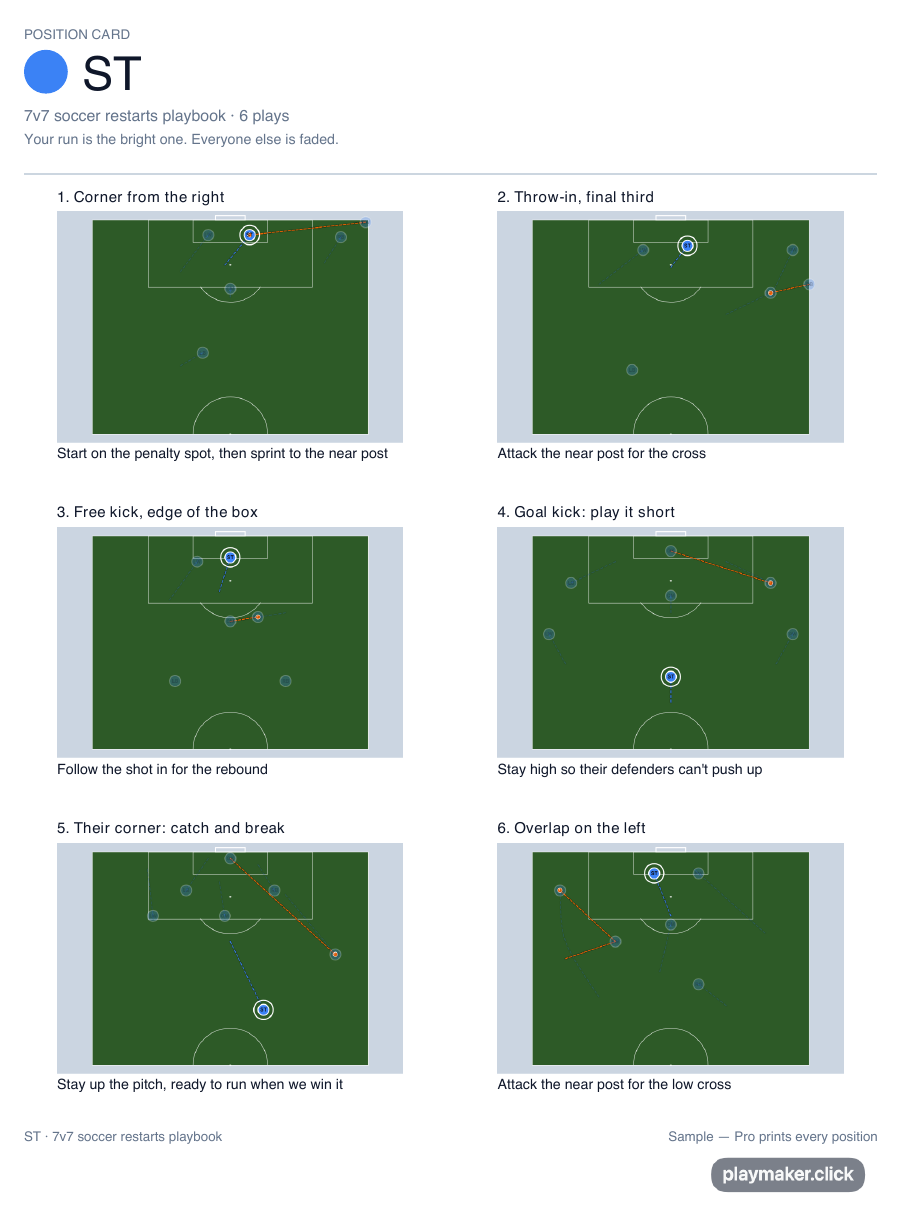
- 1Corner from the rightStart on the penalty spot, then sprint to the near post
- 2Throw-in, final thirdAttack the near post for the cross
- 3Free kick, edge of the boxFollow the shot in for the rebound
- 4Goal kick: play it shortStay high so their defenders can't push up
- 5Their corner: catch and breakStay up the pitch, ready to run when we win it
- 6Overlap on the leftAttack the near post for the low cross
A card for every player, from your own plays
Draw your plays, label each marker the way your team talks, and give each player a one-line job. Then press Position cards on the playbook. Pro prints every position, every page, with no mark; a free account prints this same one-page sample from your own plays.
How do I give each kid only their job?
Every coach of young players has watched it happen. You hand out the play sheet, you walk through it at practice, and on Saturday the left receiver runs the right receiver's route because both lines on the diagram looked like theirs. A full play card is drawn for the coach. It shows everybody, so everybody has to work out which line is them.
A position card answers that by leaving nothing else to work out. It is one page for one position. Every play in the playbook is on it, in the same order as everybody else's card. On each diagram that player's marker is ringed and their run is drawn in full colour, and the other players are faded back, so they are still there to show the shape but no longer compete for attention. Under each diagram is one line: their job on that play, in words a child can say back to you. "Run ten yards, stop, turn and come back to the ball." "Screen PG's defender, then roll hard to the basket." "Start on the penalty spot, then sprint to the near post."
The header is the position as it appears on the marker, QB, PG or ST, printed large enough to find in a pile of cards on a bench. A play that position isn't in is still on the card, as an empty box saying so, so that play 4 is in the same place on every child's card and two players comparing cards are always looking at the same play.
Try it on a starter playbook
The tool above prints from one of three short starter playbooks, each six plays long, so one page holds all of it:
- Flag football: a five-a-side team with a centre, a quarterback and X, Y and Z receivers, running mesh, double slants, a sweep, a flood, curls and a bubble screen.
- Basketball: positions one to five through a high pick and roll, a give-and-go, a backdoor cut, baseline and sideline out-of-bounds plays and a last-shot clear-out.
- Soccer: a seven-a-side team in a 2-3-1 taking corners, throw-ins, free kicks and goal kicks, defending a corner and overlapping down the left.
Pick a position and you get exactly the card a coach gets from their own playbook, made by the same code: one page, with a small playmaker.click mark at the foot. Try two or three positions and lay them side by side. You will see the point of the format faster than any description of it.
Your own plays, one card for every player
The sample is one position. A full set is one card for every position in your own playbook, and that is a Pro feature. Draw your plays in Playmaker, label each marker the way your team talks (QB, X, PG, GS, or a shirt number), give each player a one-line job on each play, then open the playbook and press Position cards. Every position prints on its own pages, so the file cuts into one stack per child, and there's no mark on any of them. A QR code at the top of each card opens the playbook on a phone, so a player who wants to see the plays move can scan their own card.
If you're starting from nothing, the formation templates put a team on the pitch in one tap. For the coach's side of the bench, the play wristband maker prints whole plays for a wrist coach, the football wristband maker prints numbered play calls, and the match-day sheet puts your set pieces on one page.
Printing it
The card prints on A4 or US Letter. Print at 100% rather than "fit to page" so the diagrams are the size they were drawn for. Card stock lasts a season in a kit bag; a plastic sleeve lasts longer. Where a play has no job written, the card leaves a ruled line so you can write one in by hand.
Position cards: common questions
Do I need an account to make a position card?
No. Pick a sport and a position and download the card. There's nothing to sign up for and nothing to install. An account is only needed to make cards from plays you have drawn yourself.
What is the difference between a position card and a play card?
A play card is one play with every player's run on it, which is what the coach needs. A position card is one player with every play on it, their own run bright and the rest faded, which is what the player needs. They are the same playbook printed two ways.
Can I make position cards from my own playbook?
Yes. Draw your plays in Playmaker, label the markers and give each player a job, then open the playbook and press Position cards. A free account prints a one-page sample of one position, the same as this page. Pro prints a card for every position, every page, with no mark.
What should I write as a player's job?
One short instruction they can repeat back to you, short enough to fit on one line of a phone. Say where to go and what to look for, like "Run to the far post" or "Catch it, then hit PG on the cut". A job that needs a second sentence is usually two plays.
Which sports can I make position cards for?
This page has starter playbooks for flag football, basketball and soccer. From your own playbook you can print position cards for any sport Playmaker draws, including rugby, field hockey, netball and baseball.
Why is everyone else on the card faded rather than removed?
Because the other players are what tell a child where they are. A receiver needs to see that the centre is beside them and Z is crossing just above them. Fading keeps the picture of the whole play and still makes one run stand out.
Page updated