Two safeties, two deep halves, one seam
American football · Defence · 11 of your players
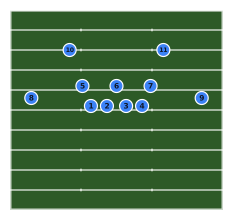
A cover two shell hands each safety exactly half of a fifty-three yard field, which is about the most a safety can genuinely cover. The seam between the two of them is the rent it pays.
Opens on a american football pitch with the shape already drawn. Free, no signup.
Where the eleven defenders stand
Four down linemen sit a yard on the defensive side of the line of scrimmage: two tackles about five yards apart over the guards, two ends outside the tackles. Three linebackers are six yards off the ball and eight and a half yards from each other, which covers the middle of the field between the hashes and not much more than that.
Both cornerbacks are wide, five yards in from their own sidelines and three yards off the line, turned to face the receivers rather than the field. And the two safeties are the formation's name: fifteen yards deep, twenty-three yards apart, one over each half of the field.
Splitting the deep half is the entire idea
Each safety owns half of a fifty-three yard field and nothing else. Half a field is a distance a safety can actually cover, which is why very little gets over the top of this coverage outside: the corner squats on the flat, forces the receiver one way, and a safety is already standing where the deep ball would land.
What it gives away is the middle. Two safeties splitting the field means neither of them owns the space between them, and the seam — up the hash, fifteen to twenty-two yards deep, behind the linebackers and in front of nobody — is where a tight end or an inside slot lives. Every offensive coordinator in the sport knows it. The bet a cover two defence makes is that a quarterback throwing there is throwing into a closing window, and that everything easier than that has been taken away.
What to test on the drawing
- Find the seam yourself. Draw a vertical up the right hash from an inside receiver and mark who covers it at eighteen yards. If the answer is the middle linebacker, animate him getting there.
- The corner's first three yards. Squatting at three is what makes the flat impossible and the deep sideline available. Draw him turning and running, and look at what he left.
- Rotate one safety. Drop one to the middle of the field and the shell becomes single-high. Save both, and let the group see how differently one route reads against each.
Open the cover two shell in the designer, put the formation you actually face on top of it, and see which of the two safeties has too much ground to cover.
Also known as
- cover two
- four three
- zone coverage
- two high
- base defence
Shapes to look at next
Five wide
Formation · 11 players
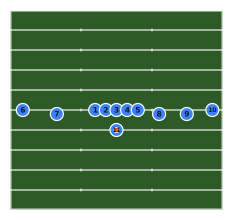
Empty backfield, five eligible receivers spread from sideline to sideline and nobody left to block but the five up front. Every defender is accounted for before the snap, which is the whole argument for it and the whole risk of it.
Read the setup
Flag 5v5 spread
Formation · 5 players
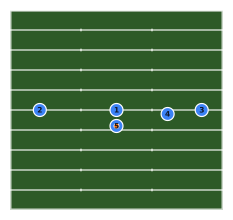
Five a side: a centre to snap it, a quarterback, and three receivers spread as wide as the field allows. With no blocking and no back, every play is a route combination and every defender is in coverage.
Read the setup
Flag 7v7 trips right
Formation · 7 players
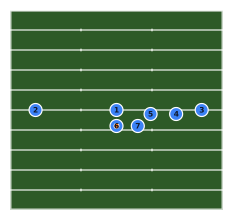
Seven a side, no line to speak of: a centre, a quarterback, a back and four eligible receivers with three of them stacked right. Flag is played on a narrower field than this one, but a yard is a yard, so the six-yard gaps between the receivers are what transfers.
Read the setup
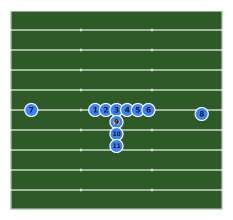
I formation
Formation · 11 players
The base two-back set: tight end and flanker to the strong side, split end isolated left, and the fullback and running back stacked directly behind the quarterback. Drawn on the 25 so a route tree has the full 25 yards to the goal line.
Read the setup
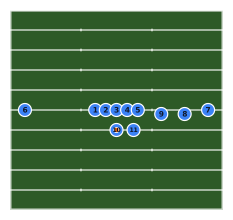
Shotgun trips right
Formation · 11 players
Three receivers stacked to the right with the back beside a shotgun quarterback, leaving the split end alone on the left. The formation that makes a defence declare where its extra defender is going before the snap.
Read the setup
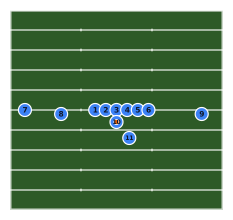
Singleback spread
Formation · 11 players
One back, one tight end and three receivers — the most common set in the sport, because it can run and throw from the same picture. Quarterback under centre, back offset behind him, slot receiver to the weak side.
Read the setup
Put the Cover two shell on a pitch
It opens with the shape already drawn. Move the players your team does differently, drag the runs, and send your squad a link that animates.
Open in PlaymakerPage updated · American football play designer · All templates