Baseball defensive alignments, every one on one page
Each alignment is drawn to scale on a full diamond, 90 ft bases and a 330 ft fence, with a line on when to call it and a page on how it works. Compare the depths here, then open the one you want and draw the throws your fielders make from it.
Free, no account, nothing to install.
Infield depth
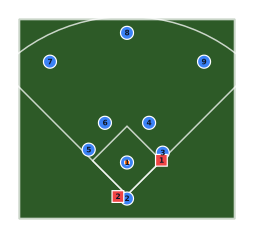
Double-play depth
Defence · 11 players
A runner on first with fewer than two out and a hitter who puts the ball on the ground. With two out there is no double play to turn, so stay at standard depth.
Read the setup
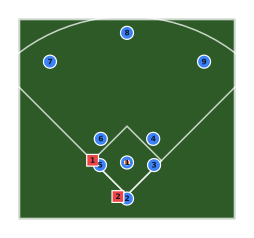
Infield in
Defence · 11 players
A runner on third in a one-run game, late, when the run matters more than the out. Decide home or first for every fielder before the pitch.
Read the setup
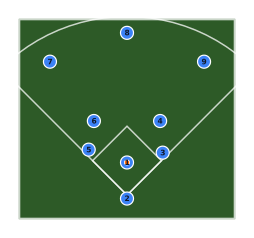
Standard fielding alignment
Defence · 9 players
Nobody on and nothing to protect. It is where all nine go without being told, and every other alignment on this page is a change from it.
Read the setup
How the infield depths compare
The situation each depth is for, where the four infielders stand, in feet from home plate, and what the alignment gives up to get what it wants. Every one is a starting point: the throws your fielders make from it are yours to draw.
| Alignment | The situation | Where the infield plays | What it gives up | The risk |
|---|---|---|---|---|
| Double-play depth | The situation: Runner on first, fewer than two out, a hitter on the ground | Where the infield plays: Second baseman and shortstop at about 140 ft instead of 150, a step toward second; the corners do not move | What it gives up: The ball in the hole to the shortstop side, and a slow roller that arrives sooner | The risk: Without a likely ground ball you give up base hits for a double play that never comes |
| Infield in | The situation: Runner on third, one run in the game, usually late | Where the infield plays: Corners on the grass at about 75 ft, second baseman and shortstop at about 115 ft, about 35 ft in from standard | What it gives up: The hard ground ball they would have handled at standard depth, and a bigger hole between corner and middle | The risk: A fielder who charges and then decides gets neither out, and a throw home that gets away with a runner on second ends a one-run game |
| Standard fielding alignment | The situation: Nobody on, no lead worth protecting | Where the infield plays: Second baseman and shortstop about 150 ft, first base about 103 ft, third base about 110 ft | What it gives up: Nothing on purpose: it is the depth every other alignment is measured from | The risk: Players who cannot find these spots unprompted, so every adjustment from them drifts |
Shading and outfield depth
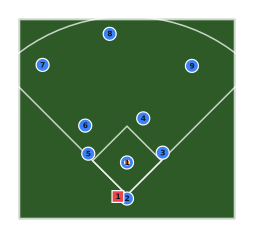
Infield shaded to the pull side
Defence · 10 players
A right-handed hitter who really does pull the ball on the ground, by the spray chart and not by a hunch. Keep two infielders on each side of second.
Read the setup
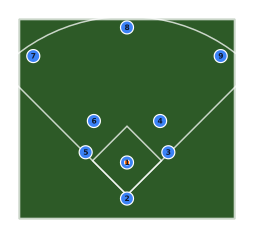
No-doubles defence
Defence · 9 players
Late, with a lead you can afford to shave, such as one run up in the ninth. A runner on first is survivable and a runner on second is not.
Read the setup
How the shade and the no-doubles defense compare
One moves the defense sideways for the hitter, the other moves it toward the lines and deeper for the score.
| Alignment | The situation | Where the fielders play | What it gives up | The risk |
|---|---|---|---|---|
| Infield shaded to the pull side | The situation: A right-handed hitter who pulls the ball on the ground | Where the fielders play: Third base on the line at about 105 ft, shortstop about 150 ft toward the hole, second baseman about 145 ft, first base about 103 ft | What it gives up: The opposite-field ground ball into left, and the bunt down the third-base line | The risk: A penalty for an infielder off the dirt, or three on one side of second, when the pitch is released |
| No-doubles defence | The situation: Late innings with a lead, such as one run up in the ninth | Where the fielders play: Corners on the lines at about 110 ft, middle infielders at their standard 150 ft, outfield at about 310 ft and spread toward the gaps | What it gives up: Singles: balls in front of the outfielders, and up the middle past the corners | The risk: Called two innings too early, it concedes four singles instead of one double |
The bunt and the runner at first
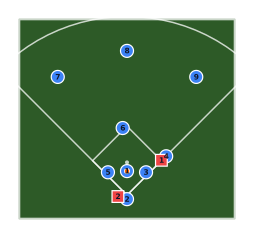
Bunt defence (corners in)
Defence · 11 players
A sacrifice bunt is coming and you want the lead runner: runner on first, no outs, a one-run game, and a hitter who has shown bunt.
Read the setup
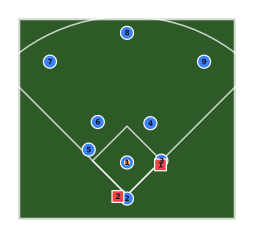
Holding the runner at first
Defence · 11 players
A runner on first with a big lead in a close game. Not a slow runner in a four-run game, where the hole costs you ground balls for nothing.
Read the setup
How the bunt defense and holding the runner compare
Both are coverage plays: who takes which bag matters more than where anyone starts.
| Alignment | The situation | Where the infield plays | What it gives up | The risk |
|---|---|---|---|---|
| Bunt defence (corners in) | The situation: Runner on first, no outs, a one-run game, a hitter who has shown bunt | Where the infield plays: Corners charging from about 55 ft, pitcher off the mound at about 44 ft, second baseman covering first, shortstop to second at about 124 ft | What it gives up: Two big holes for a hitter who reads it and swings, with the second baseman out of position | The risk: First base uncovered: the second baseman has to reach the bag before the throw does |
| Holding the runner at first | The situation: Runner on first with a big lead, a close game | Where the infield plays: First base on the bag at 90 ft instead of about 103 ft, second baseman about 140 ft leaning toward second, shortstop about 145 ft | What it gives up: The hole on the right side, where a left-handed hitter pulls the ball | The risk: Second base and shortstop both going for the steal throw, or both staying |
What a defensive alignment is
Baseball has no formations in the way soccer or football does. The same nine players take the same nine positions every inning, so what a coach decides is how deep they play and how far round, for this hitter, these runners, this many outs and this score. That decision is the alignment, and it is a distance argument: double-play depth is about 140 ft rather than 150, and the whole trade, a step less to the bag and a step less range in the hole, is in those ten feet.
Every alignment here is drawn on a diamond to scale, with the bases 90 ft apart, the mound at 60 ft 6 in and the fence at 330 ft. Most of them put the runners and the batter on the same picture as the fielders, because the reason for the alignment is the runner it is reacting to.
Teaching alignments to your team
Start with the standard fielding alignment. Left field and right field at about 285 ft, center field at 300 ft, the middle infielders at about 150 ft. Stand your players where they think those spots are, then pace it out: the gap between what they believe and the tape is the coaching point. If they cannot find the standard spots unprompted, every other alignment gets taught as a fixed position rather than an adjustment, and it drifts.
Then teach each of the others as a change from it, and say the change out loud: two players ten feet in for double-play depth, all four infielders onto the grass for infield in, the corners onto the lines and the outfield back to about 310 ft for no doubles. The bunt defense and holding the runner are coverage plays, where who takes which bag matters more than where anyone starts, so draw the throw and press play. For the standard bunt coverage and the wheel play animated in the page, read the baseball bunt defense guide.
Baseball defensive alignments: common questions
When should you play the infield in?
With a runner on third in a one-run game, usually late, when the run matters more than the out. The corners come in to about 75 ft and the middle infielders to about 115 ft, so a routine ground ball becomes a throw home. The outfield stays deep, because a runner on third does not change what a fly ball does.
What is double-play depth in baseball?
The second baseman and shortstop move in from about 150 ft to about 140 ft and a step toward second, so either can take the feed at the bag and turn two. It is for a runner on first with fewer than two out. The ten feet cost range in the hole, so the ball to the shortstop side gets through more often.
What is a no-doubles defense?
A late-innings alignment for protecting a lead. The corners move onto the foul lines at about 110 ft and the outfielders play about 310 ft, twenty feet off a 330 ft fence, spread toward the gaps. It concedes the single to take away the hit that puts a runner in scoring position.
Is the infield shift still legal?
A shade is. Since 2023 two infielders have to be on each side of second base, with all four on the infield dirt when the pitch is released. Within that, the shortstop can go as far round toward the hole as he likes, third base can play the line and the outfield can rotate with them.
Who covers first base on a bunt?
In the bunt defense here, the second baseman. Both corners charge from about 55 ft and the pitcher comes off the mound toward the plate, so the second baseman runs to first and the shortstop takes second. First base left uncovered is the most common way the play fails.
Can I change an alignment after I open it?
Yes. Every alignment opens on the full diamond as a starting picture. Drag any fielder to where your team really plays, draw the throws and the runners, press play to watch it move, and send your team the link. It is free and you do not need an account.
Draw your own alignment
Open a baseball diamond, place your nine, draw the throws and the runners and press play. Free, and you do not need an account.
Open a baseball diamondPage updated · Baseball play designer · All baseball templates