Basketball formations, every set on one page
Each set is drawn to scale on a real court, with a line on when to use it and a page on how it works. Compare them here, then open the one you want and draw the cuts, screens and passes your team runs from it.
Free, no account, nothing to install.
Half-court offenses
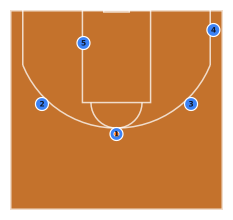
4-out 1-in
Attack · 5 players
When you have a real post player and want to keep him on the block without crowding the drive.
Read the setup
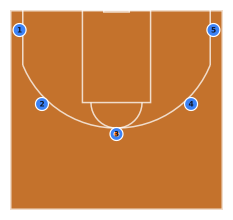
5-out
Attack · 5 players
The set to start a youth team in. Five outside the arc and an empty lane, so every drive meets one defender, not two.
Read the setup
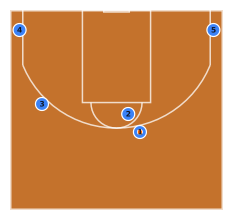
High pick and roll
Attack · 5 players
When your best decision-maker has the ball, late in the shot clock, or when you want their big defending forty feet from the rim.
Read the setup
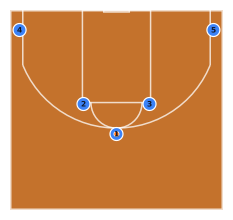
Horns
Attack · 5 players
Out of a timeout, when you want three options from one entry and a defense that cannot tell which side the play is going.
Read the setup
How the half-court offenses compare
Where each set puts its five, outside the three-point line and inside it, and what that spacing is good and bad at. Every set is a starting point: the cuts, screens and passes are yours to draw.
| Set | Outside the arc | Inside the arc | Strength | Weakness | Who it suits |
|---|---|---|---|---|---|
| 4-out 1-in | Outside the arc: Four: the top, both wings and the right corner | Inside the arc: One post on the left block, with the corner below him empty | Strength: A real inside target, with the right side of the lane still open for a drive | Weakness: Only works with a post who can catch and finish through contact | Who it suits: A team with one genuine inside player |
| 5-out | Outside the arc: All five: both corners, both wings and the top of the key | Inside the arc: Nobody, so the lane is empty | Strength: A defender who helps on a drive has to leave a shooter, from a long way away | Weakness: Nobody near the rim for a rebound, and five on the perimeter can all be denied | Who it suits: Youth teams learning to drive, cut and pass, and any team whose five can handle |
| High pick and roll | Outside the arc: The handler, a shooter in each corner and the lifted weak-side wing | Inside the arc: The screener, who rolls into an empty paint | Strength: Help defenders are a full pass away, so the roll man has the whole paint | Weakness: A defense that traps the ball screen hard with two long guards | Who it suits: A team with a good decision-maker on the ball, and the end of the shot clock |
| Horns | Outside the arc: The ball at the top and a shooter in each corner | Inside the arc: Two bigs on the elbows, with the lane below them empty | Strength: Two screens on the same dribble, and nothing tells the defense which side is next | Weakness: Less useful when the elbows are guarded by players quick enough to reach the corners | Who it suits: Coming out of a timeout, with two bigs who can screen |
Zone defenses
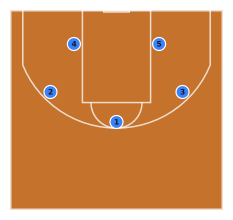
1-2-2 zone
Defence · 5 players
When the other team has one real ball handler, and you want deflections that turn into fast breaks.
Read the setup
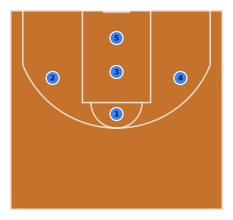
1-3-1 zone
Defence · 5 players
When the other team runs its offense through the high post, and you have a long, active defender for the middle.
Read the setup
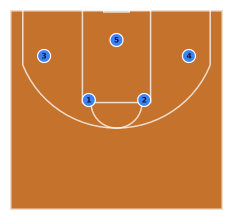
2-3 zone
Defence · 5 players
When the other team drives to the rim and cannot shoot, or when your guards are in foul trouble.
Read the setup
How the zones compare
Every zone gives something up on purpose. Here is what each one takes away, where it is soft, and when to play it.
| Zone | Where the five stand | What it takes away | Where it is soft | Play it when |
|---|---|---|---|---|
| 1-2-2 zone | Where the five stand: One at the point, one on each wing, two low just outside the blocks | What it takes away: Time on the ball: it meets the handler high, and the pass into the middle is bait | Where it is soft: Shooters in the corners, and rebounds, since neither low defender starts inside | Play it when: The other team has one real ball handler, and you want the game to go faster |
| 1-3-1 zone | Where the five stand: One at the point, a wing each side with a defender in the lane, one on the baseline | What it takes away: The high post, and the corners, where two defenders trap against the lines | Where it is soft: One defender covers the whole baseline, so the skip pass and two posts low hurt it | Play it when: You have a long middle defender and a baseline defender who will really run |
| 2-3 zone | Where the five stand: Two guards at the free-throw line, a forward outside each block, the center at the rim | What it takes away: Layups and rebounds: three defenders are low for every shot | Where it is soft: The gap between the two guards, the short corners and the skip pass | Play it when: The other team drives and cannot shoot, or has one big who wants the block |
Full-court press and press break
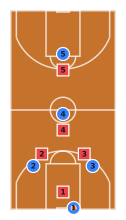
Press break
Attack · 10 players
When the other team presses after every basket: two outlets for the first pass, one in the middle and a long man waiting for the layup.
Read the setup
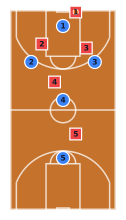
Full-court diamond press
Defence · 10 players
After a made basket, when you are fitter or deeper than the other team, or need turnovers to get back into a game.
Read the setup
What a basketball formation is
A basketball formation, or set, is where your five stand before the action starts. On offense it is a question of spacing: how many players are outside the three-point line, and who, if anyone, is inside it. Five out leaves the lane empty for drives and cuts. Four out keeps one player on the block. Horns puts two bigs on the elbows, and the high pick and roll brings the screener out above the arc to meet the ball.
On defense the numbers name the zone, read from the top of the floor to the baseline. A 2-3 is two guards up and three along the bottom; a 1-3-1 is one at the point, three across the middle and one on the baseline; a 1-2-2 is one at the point, two on the wings and two low. Each one gives up something on purpose, and the table above says what.
A set is where a possession starts, not the possession. Open any one of these on the court, then draw the cuts, the screens and the passes, and press play to watch it run.
Picking sets for a youth team
Start on offense with 5-out. It teaches driving, cutting and passing without asking a twelve-year-old to understand post play first, and its one rule, nobody drifts into the lane, is easy to see on a diagram. Add 4-out 1-in when you have a player who can catch on the block and finish through contact. Horns and the high pick and roll ask more: a guard who reads the defense, and screeners who set the angle you want.
On defense, the 2-3 is the zone most teams learn first, because the lane is filled and the rim is guarded before anybody moves. It asks the other team to beat it with jump shots and patience, and most young teams do not have both on the same night. When a team does, the basketball plays against a 2-3 zone guide shows the gaps they will go after.
The press and the press break belong together. The diamond press tries to trap the first pass on the sideline; the press break gives the inbounder two targets and a player in the middle of the floor, which is where most presses end. Both are drawn on the full court in the basketball play designer.
Basketball formations: common questions
What is the best basketball formation for a youth team?
5-out. All five players stand outside the three-point line, so the lane is empty and the first player to drive meets one defender rather than two. It teaches driving, cutting and passing before post play, which makes it the place to start a young team.
What is the difference between a 2-3 zone and a 1-3-1 zone?
A 2-3 puts two guards at the free-throw line and three defenders along the baseline, so it protects the paint and the boards and gives up jump shots. A 1-3-1 puts one at the point, three across the middle with a defender in the lane, and one on the baseline, so it takes away the high post and traps the corners, but one defender has to cover the whole baseline.
Where is a 2-3 zone weak?
In three places: the gap on the free-throw line between the two guards, the short corner beside each block, and the skip pass that gets the ball across the floor faster than the zone can shift. Draw the zone as the other team, then draw your offense attacking those three spots.
How do you break a full-court press?
Give the inbounder two targets, a guard on each side at the free-throw line extended, and put a player in the middle at half court. The guard who catches the first pass looks to the middle at once, before the trap arrives. A catch in the middle of the floor beats most presses, because every trapper is now behind the ball.
Can I change a set after I open it?
Yes. Every set opens on the court as a starting picture. Drag any player to a new spot, add the other team, draw the cuts, screens and passes, press play to watch it move, and send your team the link. It is free and you do not need an account.
Draw your own set
Open a basketball court, place your five, draw the cuts, screens and passes and press play. Free, and you do not need an account.
Open a basketball courtPage updated · Basketball play designer · All basketball templates