Field hockey formations, every shape on one page
Each shape is drawn to scale on a pitch with a real shooting circle and 23 m line, with a line on when to use it and a page on how it works. Compare them here, then open the one you want and draw the runs and passes your side plays from it.
Free, no account, nothing to install.
Outfield formations
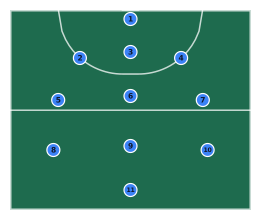
3-3-3-1
Formation · 11 players
When you want the ball and your squad can pass while being closed down. Three lines of three, about ten metres apart, give everyone a short pass to two teammates.
Read the setup
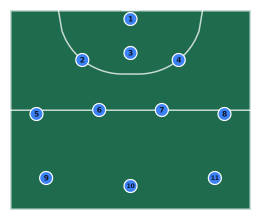
3-4-3
Formation · 11 players
When you are chasing a game, or are the better side and want to pin them in their own 23. Both wide midfielders push on and it becomes a front five.
Read the setup
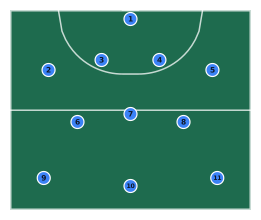
4-3-3
Formation · 11 players
When you want a settled team rather than a clever one. Four at the back covers the width, and the front three are three pressers the moment the ball turns over.
Read the setup
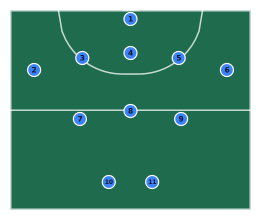
5-3-2
Formation · 11 players
When you are protecting something: a lead, a first leg, or a fixture against a dangerous forward line. The sweeper means nobody defends a one-on-one alone.
Read the setup
How the outfield formations compare
Where each shape puts its ten outfield players, how wide it plays, and what it is good and bad at. Every one is a starting point: the runs and passes your side makes from it are yours to draw.
| Formation | Back | Midfield | Front | Width | Strength | Weakness |
|---|---|---|---|---|---|---|
| 3-3-3-1 | Back: Three, narrow, about inside the width of the circle | Midfield: Three just inside your own 23, and three attacking midfielders above | Front: One striker, alone near halfway | Width: Grows up the pitch: narrow backs, the attacking three widest | Strength: A short pass to two teammates for everyone, and a spare receiver beside the press | Weakness: A turnover leaves three backs facing a front three, and one striker cannot press two |
| 3-4-3 | Back: Three across the top of your own quarter, close together | Midfield: Four, the outside pair about six metres from each sideline | Front: Three on halfway: a centre forward and two wings | Width: The full 55 metres, before the forwards have touched the ball | Strength: Five attackers once both wide midfielders push, and circle entries from the side | Weakness: The corridor behind a wide midfielder who is 40 metres upfield when the ball turns over |
| 4-3-3 | Back: Four, centre backs either side of the goal, outside pair wider | Midfield: Three on and just past the 23 m line, about fourteen metres apart | Front: Three, wings near the sideline, centre forward highest | Width: Both wings on the sideline, and a back four that covers a switch | Strength: A settled shape that matches most midfields, with three pressers up front | Weakness: Against a 3-3-3-1, a player short in the middle third |
| 5-3-2 | Back: Five, a sweeper behind two centre backs, outside backs high and wide | Midfield: Three on the 23 m line | Front: Two near halfway, close enough to press the same defender | Width: The outside backs, out towards the sidelines | Strength: A spare defender, so nobody defends a one-on-one without help | Weakness: Passivity: eleven inside your own 23, conceding the corner you were avoiding |
Pressing
The penalty corner, attack and defence
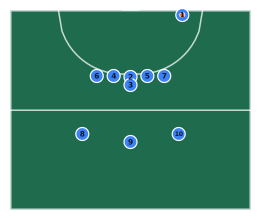
Penalty corner attack
Set piece · 10 players
Every routine you own starts from this picture: injector ten metres from the post, everyone else outside the circle. Each variation moves one player.
Read the setup
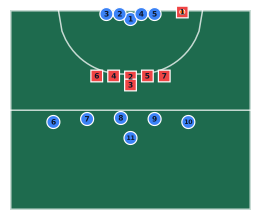
Penalty corner defence
Set piece · 18 players
Several times most weeks, usually when you are ahead and tired. Keeper and four on the line, the other six beyond the centre line until the ball is played.
Read the setup
What a field hockey formation is
A field hockey formation is where your ten outfield players stand in front of the goalkeeper, read from the back: a 4-3-3 is four backs, three midfielders and three forwards, and a 3-3-3-1 adds a fourth line, with one striker above three attacking midfielders. The numbers say who is in each line. The spacing between the lines, and how wide each one plays, is what makes two shapes with the same numbers play differently, and the drawings on this page put every player where the template puts them, on a pitch with a real shooting circle and 23 m line.
A formation is where a game starts, not the game. Open any one of these on the pitch, move the two or three players your side sets differently, then draw the runs and the passes and press play to watch it move.
Picking a formation for a junior or club side
The 4-3-3 is the shape most club sides start from, and it is the place to start a team that is new to eleven a side: four at the back cover the width, three in midfield match most opponents, and every player has a line to stand in. The habit to teach first is the wings staying on the sideline, because a wing five metres infield hands back the width the back four paid for.
The 3-3-3-1 asks more. It is built for a squad that can pass while being closed down, with the lines about ten metres apart so every pass is a push rather than a hit. The 3-4-3 is an attacking shape that turns into a front five, and it only survives if the two central midfielders fill the gap behind a wide midfielder who has gone. The 5-3-2 is the one to reach for when you are protecting a lead, as long as only one outside back goes forward at a time.
The press and the penalty corner
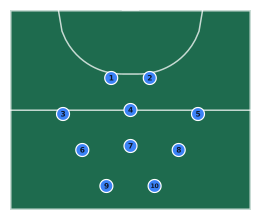
The full press is not a formation you line up in. It is ten outfielders pressing high in a 2-3-3-2, with two on the edge of the shooting circle and the keeper off screen in your own half, and it is a shape for nominated moments rather than a whole half.
The two penalty corner templates are drawn the way the rules make you set up. In attack the injector is on the backline ten metres from the post and every other attacker starts outside the circle. In defence the goalkeeper and four defenders are on the goal line and the other six are beyond the centre line until the ball is played, with the seven attackers drawn in, so you are drawing your defence against the thing it has to stop. The field hockey penalty corner routines guide animates two routines to start from.
Field hockey formations: common questions
What is the most common field hockey formation?
The 4-3-3. Four at the back, three in a midfield band across the 23 m line and three forwards holding the width up on halfway. It is the shape most club sides start from, because it covers the width, matches most midfields and gives you three pressers the moment the ball is turned over near their circle.
What is the difference between a 3-3-3-1 and a 4-3-3?
A 3-3-3-1 plays one fewer at the back and an extra line in front of the midfield: three backs, three midfielders, three attacking midfielders and a lone striker. A 4-3-3 plays a back four, a midfield three and a front three. Against a 3-3-3-1, a 4-3-3 is a player short in the middle third, and one wing tucking in is the usual answer.
How many players are on a field hockey team?
Eleven on the pitch: a goalkeeper and ten outfield players. Every outfield formation on this page is drawn with all eleven. The full press and the attacking penalty corner show ten, because in both your keeper is back in your own half.
Where does everyone stand at a penalty corner?
In attack, the injector is on the backline ten metres from the post, and every other attacker starts with feet and stick outside the shooting circle: the trapper and striker at the top of the circle, two slips, two post runners and three players back as rest defence. In defence, no more than five defenders, keeper included, are behind the back-line, and the other six must be beyond the centre line until the ball is played.
Can I change a formation after I open it?
Yes. Every formation opens on the pitch as a starting picture. Drag any player to a new spot, add the opposition, draw the runs and passes, press play to watch it move, and send your team the link. It is free and you do not need an account.
Draw your own formation
Open a field hockey pitch, place your eleven, drag their runs, draw the passes and press play. Free, and you do not need an account.
Open a hockey pitchPage updated · Field hockey play designer · All field hockey templates