Soccer formations, every shape on one page
Each shape is drawn to scale on the pitch it is played on, with a line on when to use it and a page on how it works. Compare them here, then open the one you want and move the players your team does differently.
Free, no account, nothing to install.
Eleven a side (11v11)
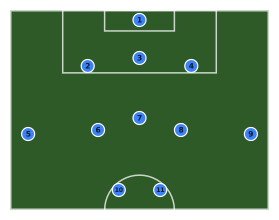
3-5-2
Formation · 11 players
When you have three centre backs and two wing backs fit enough to cover a touchline each.
Read the setup
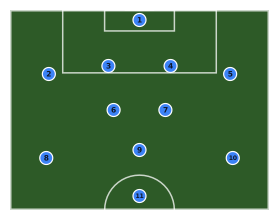
4-2-3-1
Formation · 11 players
When you want two holders in front of the back four and a playmaker behind the striker.
Read the setup
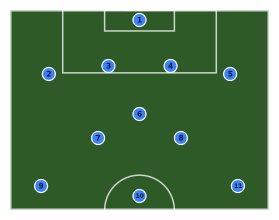
4-3-3
Formation · 11 players
When you want the ball, and you have the legs to press high as soon as you lose it.
Read the setup
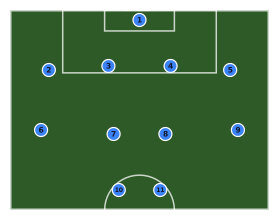
4-4-2
Formation · 11 players
When you want a shape every player understands, and two strikers to break with.
Read the setup
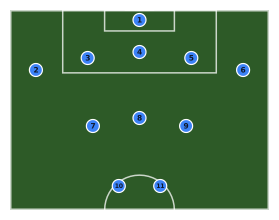
5-3-2 low block
Defence · 11 players
When you are protecting a lead and want the middle of the penalty area crowded.
Read the setup
How the 11v11 formations compare
Where each shape puts its ten outfield players, and what it is good and bad at. Every one is a starting point: the shape your team makes with the ball and without it is yours to draw.
| Formation | Back line | Midfield | Front line | Strength | Weakness |
|---|---|---|---|---|---|
| 3-5-2 | Back line: Three | Midfield: Five: two wing backs and a midfield three | Front line: Two strikers | Strength: Numbers in central midfield, and a strike pair | Weakness: The wing backs cover a whole flank, and there is space behind them |
| 4-2-3-1 | Back line: Four | Midfield: Two holders and three attacking midfielders | Front line: One striker | Strength: Solid through the middle, with a number ten between the lines | Weakness: The lone striker can be left isolated |
| 4-3-3 | Back line: Four | Midfield: Three: one holder, two eights | Front line: Three: two wingers and a striker | Strength: Width high up the pitch, and three players to press from the front | Weakness: One holding midfielder can be outnumbered in the middle |
| 4-4-2 | Back line: Four | Midfield: Four, flat, with two wide | Front line: Two strikers | Strength: Simple to learn, with two compact banks and both flanks covered | Weakness: Two central midfielders can be outnumbered by a midfield three |
| 5-3-2 low block | Back line: Five | Midfield: Three | Front line: Two strikers | Strength: Very hard to break down around your own penalty area | Weakness: Gives up the ball and territory, with few players left to attack |
Small-sided formations for youth soccer
Most players under thirteen play seven or nine a side. These shapes are drawn on their own smaller pitches, not cut down from eleven. For the ages that play each format and the build-out line, see the youth soccer play designer.
Nine a side (9v9)
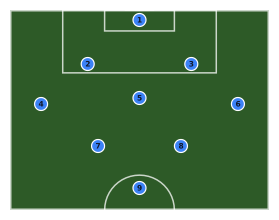
9v9 2-3-2-1
Formation · 9 players
When an older team wants the ball and both centre backs are comfortable on it.
Read the setup
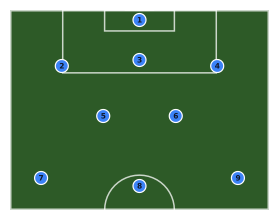
9v9 3-2-3
Formation · 9 players
When your team is ready to attack with wingers, and as the step towards the 4-3-3.
Read the setup
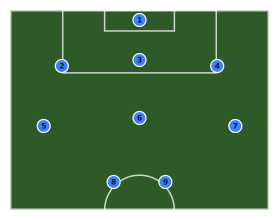
9v9 3-3-2
Formation · 9 players
When a team is new to nine a side and needs a player in every lane.
Read the setup
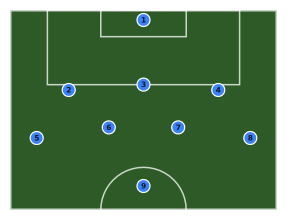
9v9 3-4-1
Formation · 9 players
When you keep losing midfield or conceding on the break, and want a spare defender.
Read the setup
Seven a side (7v7)
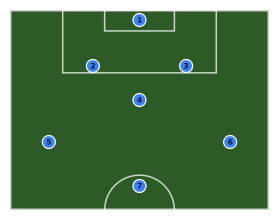
7v7 2-1-2-1
Formation · 7 players
When you want to teach passing triangles, with a holding player in the middle.
Read the setup
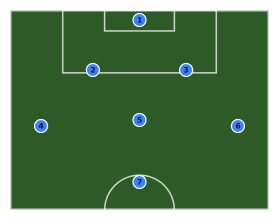
7v7 2-3-1
Formation · 7 players
The default for under-9s: every child has a lane, and nobody is the last defender alone.
Read the setup
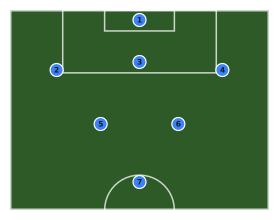
7v7 3-2-1
Formation · 7 players
When a young team keeps conceding on the counter and needs a spare defender.
Read the setup
What a formation tells you, and what it does not
A formation is read from the back: a 4-3-3 is four defenders, three midfielders and three forwards, and the goalkeeper is never counted. The small-sided shapes work the same way, so a 9v9 3-2-3 is three at the back, two in the middle and three up front, eight outfield players in all.
The numbers are where the players start, not where they stay. A 4-3-3 that loses the ball often defends as a 4-5-1, with the wingers dropping in beside the midfield, and a 3-5-2 whose wing backs retreat becomes a back five. That is why each shape here is a picture to start from rather than a finished plan: open it, then drag the runs and the shape your team makes with the ball and without it.
Picking a shape for your players
Start from who you have, not from the shape you watched on television. Three good centre backs make a back three worth trying; one midfielder who reads the game makes a single holder possible; two strikers who like each other make a front two worth keeping. If you are not sure, the 4-4-2 is the easiest shape to teach and the 4-3-3 is the one most clubs grow their players into.
For young players the size of the game decides first. Most children under thirteen play seven or nine a side, and an eleven-a-side shape with players deleted is not a small-sided formation. The 9v9 and 7v7 shapes on this page are drawn on their own pitches, and the youth soccer play designer has the ages each format is played at and the build-out line that shapes them.
Soccer formations: common questions
What is the most common soccer formation?
At eleven a side the 4-4-2, the 4-3-3 and the 4-2-3-1 are the shapes you will meet most often, at every level from grassroots to professional. All three keep a back four, and the difference between them is how the six players in front of it are shared out.
Which soccer formation is easiest to teach?
The 4-4-2. Every player has a partner beside them and a clear line to hold, so a team can learn to defend as two banks of four in a few sessions. It is a good first shape before you ask a team to play with a single holding midfielder or a back three.
What do the numbers in a soccer formation mean?
They count the outfield players line by line, from the back to the front. The goalkeeper is left out, so the numbers in an eleven-a-side formation add up to ten, in a nine-a-side one to eight, and in a seven-a-side one to six.
Can I change a formation after I open it?
Yes. Every formation opens on the canvas as a starting picture. Drag any player to a new spot, draw their runs and passes, press play to watch it move, and send your team the link. It is free and you do not need an account.
Draw your own formation
Open a soccer pitch, place your players, drag their runs and press play. Free, and you do not need an account.
Open a soccer pitchPage updated · Soccer play designer · All soccer templates