The 7v7 3-2-1, a spare defender behind the ball
Soccer · Formation · 7 of your players
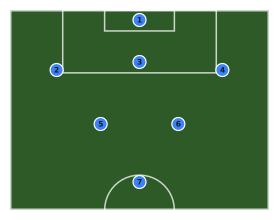
Three across the back, two in central midfield and one up front. The steadier seven-a-side shape, for the week your team keeps losing the ball in midfield and watching the other side run through on goal.
Opens on a soccer pitch with the shape already drawn. Free, no signup.
How the shape works
The goalkeeper, then a back three: a centre back in front of goal and two outside backs standing wider, level with the edge of the penalty area. Ahead of them two central midfielders share the middle of the pitch, and a single striker plays up near halfway.
What the 7v7 3-2-1 buys is the spare defender. When the ball is lost in midfield, the other team's striker has three players to beat rather than two, and one of them can always step in while the other two cover. For a team of eight-year-olds who have not yet learned to recover their shape, that extra body is the difference between a goal against and a goal kick.
What it costs
Width further up. With two central midfielders and nobody on the touchlines, the outside backs have to be the width when your team has the ball, and that means stepping into midfield with it. Coach that early. A 3-2-1 whose outside backs never cross halfway is a shape that defends well and never scores, and the striker spends the game alone.
What to coach
- The outside back's run. Draw the left back carrying the ball up the touchline while the centre back slides across to cover, and animate it. That is the whole idea of the shape in one move.
- Two midfielders, two jobs. One goes, one stays. Put the two central players on the same diagram and draw only the one who goes forward.
- When to change. Once the team stops conceding on the break, move to the 2-3-1 and give the third defender a touchline in midfield instead.
Open the 7v7 3-2-1 in the designer and draw the outside back's run first.
Also known as
- youth soccer
- 7v7
- seven a side
- back three
- small sided
Shapes to look at next
3-5-2
Formation · 11 players
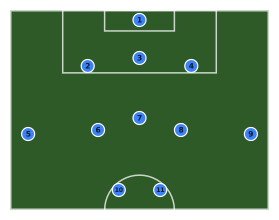
Three centre backs, wing backs pushed high and wide onto the touchlines, a midfield three inside them and a front two. Overloads the middle and asks the wing backs to cover the whole flank.
Read the setup
4-2-3-1
Formation · 11 players
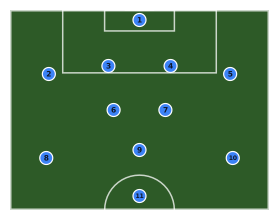
Back four, a double pivot screening in front of them, three attacking midfielders and a lone striker. The modern default: solid through the middle with a number ten between the lines.
Read the setup
4-3-3
Formation · 11 players
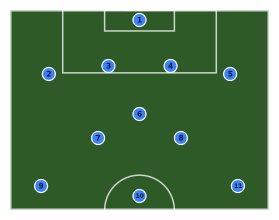
Back four, a single pivot with two eights ahead of them, and a front three holding the width. The wingers sit on the touchlines so the full backs have the space to overlap.
Read the setup
4-4-2
Formation · 11 players
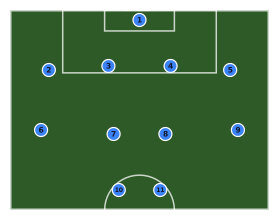
The classic two banks of four with a front pair. Drawn as a mid block defending the goal at the top: back four on the edge of the penalty area, midfield four across the middle third, strikers up on the halfway line.
Read the setup
7v7 2-1-2-1
Formation · 7 players
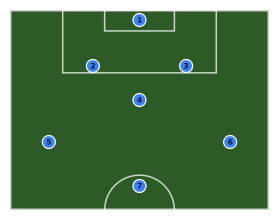
Seven a side as a diamond: two centre backs, one holding midfielder, two wide players and a striker. It teaches the triangles every older shape is made of, and asks the holding player to read the game early.
Read the setup
7v7 2-3-1
Formation · 7 players
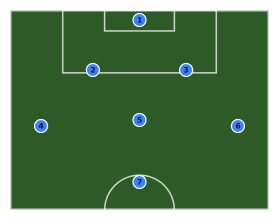
Seven a side: a keeper, two centre backs, a midfield three across the pitch and one striker. The most common 7v7 shape, because every player has a clear lane and nobody is left alone at the back.
Read the setup
Put the 7v7 3-2-1 on a pitch
It opens with the shape already drawn. Move the players your team does differently, drag the runs, and send your squad a link that animates.
Open in PlaymakerPage updated · Soccer play designer · All templates