The 7v7 2-1-2-1, a diamond made of triangles
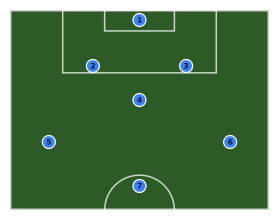
Soccer · Formation · 7 of your players
Two centre backs, a holding midfielder between them and the wide players, and one striker at the top. Every player in the diamond has two passes on, which is the habit a young team most needs to learn before nine a side.
Opens on a soccer pitch with the shape already drawn. Free, no signup.
How the shape works
Four lines instead of three. The two centre backs sit wide of the goal, the holding midfielder stands in the middle just in front of them, the two wide players play high on each touchline, and the striker leads the line near halfway. Join the dots and the outfield six make a diamond with a base: centre backs, then the holder, then the two wide players, then the striker.
The 7v7 2-1-2-1 is the shape that teaches triangles. The holding player always has a centre back on either side behind them and a wide player on either side ahead, so they can turn either way. Each wide player has the holder inside and the striker ahead. Nobody receives the ball with only one option, and a young player with two options learns to look up.
Who it suits
A team that already passes a little. The holding position is the hardest job on a 7v7 pitch, because that player has to be in the right place before the ball arrives rather than after, and it asks more reading of the game than a 2-3-1's central midfielder. Rotate it, but expect it to look messy for the first few weeks. It is worth it: under-10s who have played the diamond arrive at 9v9 already knowing what a triangle is for.
What to draw on it
- Holder to wide player to striker. Three passes, three players, one triangle. Animate it and the shape explains itself.
- The holder's cover. When a centre back steps out, draw the holder dropping into the gap. That is the defensive half of the job.
- Wide players on the paint. Same lesson as every small-sided shape: if the wide player drifts inside, the triangle closes up.
Open the 7v7 2-1-2-1 in the designer and draw the first triangle off the keeper's pass.
Also known as
- youth soccer
- 7v7
- seven a side
- diamond
- small sided
Shapes to look at next
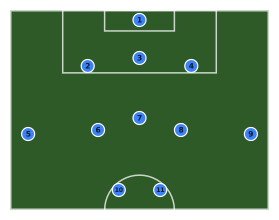
3-5-2
Formation · 11 players
Three centre backs, wing backs pushed high and wide onto the touchlines, a midfield three inside them and a front two. Overloads the middle and asks the wing backs to cover the whole flank.
Read the setup
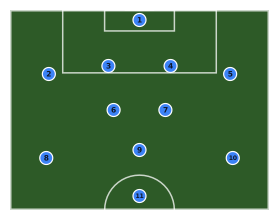
4-2-3-1
Formation · 11 players
Back four, a double pivot screening in front of them, three attacking midfielders and a lone striker. The modern default: solid through the middle with a number ten between the lines.
Read the setup
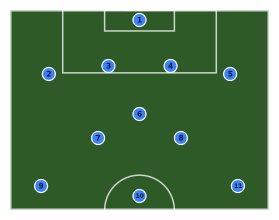
4-3-3
Formation · 11 players
Back four, a single pivot with two eights ahead of them, and a front three holding the width. The wingers sit on the touchlines so the full backs have the space to overlap.
Read the setup
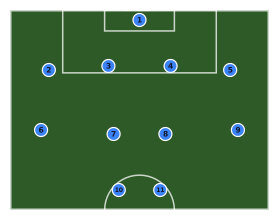
4-4-2
Formation · 11 players
The classic two banks of four with a front pair. Drawn as a mid block defending the goal at the top: back four on the edge of the penalty area, midfield four across the middle third, strikers up on the halfway line.
Read the setup
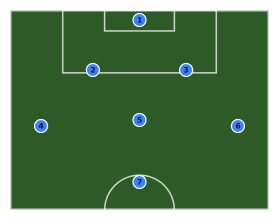
7v7 2-3-1
Formation · 7 players
Seven a side: a keeper, two centre backs, a midfield three across the pitch and one striker. The most common 7v7 shape, because every player has a clear lane and nobody is left alone at the back.
Read the setup
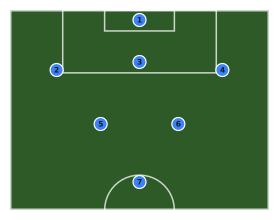
7v7 3-2-1
Formation · 7 players
Seven a side with three at the back, two central midfielders and a striker. The safer shape for a young team that concedes on the counter: a spare defender behind the ball, at the cost of width further up.
Read the setup
Put the 7v7 2-1-2-1 on a pitch
It opens with the shape already drawn. Move the players your team does differently, drag the runs, and send your squad a link that animates.
Open in PlaymakerPage updated · Soccer play designer · All templates