The 7v7 2-3-1, the shape most under-9s start in
Soccer · Formation · 7 of your players
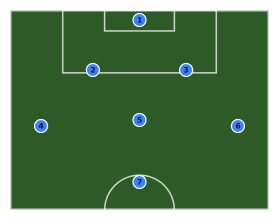
Two centre backs, three midfielders across the width and a striker. It is the most common seven-a-side formation because every child has a lane, a neighbour and a job they can see from where they stand.
Opens on a soccer pitch with the shape already drawn. Free, no signup.
How the shape works
A goalkeeper and six outfield players in three lines. Two centre backs stand either side of the goal, a midfield three runs from one touchline to the other, and one striker plays on the shoulder of the last defender. Drawn on this pitch in proportion: the back two about a third of the way up the half, the midfield just past the middle of it, and the striker close to halfway, which is where a 7v7 striker stands when the team is set.
The reason it is the default is the middle line. Three across the width means the two wide midfielders own a touchline each and the central one owns the middle, so no child is ever asked to cover a lane that belongs to somebody else. And two at the back means neither defender is ever the last player alone: when one steps up to win the ball, the other is already beside the goal behind them.
What it teaches
- Width. The wide midfielders stand on the touchlines with the ball. A young team bunches around the ball by instinct, and a 7v7 2-3-1 drawn with the wide players on the paint is the picture that argues back.
- Playing out. With a build-out line or a retreat line, the two centre backs split wide either side of the goal when your keeper has the ball. That is two easy passes, and it is the first pattern worth animating.
- A target. The striker is the outlet when the ball has to go forward quickly. Draw them checking back towards the ball and the midfield three running past.
What to watch for
The central midfielder does the most running in this shape, and in a young team they tend to get pulled to the ball wherever it is. Rotate the position every quarter so no one child does it all game. And when you are losing the midfield battle, the usual fix is to drop the striker into a midfield four for ten minutes, not to add a third defender.
Open the 7v7 2-3-1 in the designer, drag the two centre backs out to the edges of the box, and animate the first pass out of the keeper's hands.
Also known as
- youth soccer
- 7v7
- seven a side
- small sided
- build out
Shapes to look at next
3-5-2
Formation · 11 players
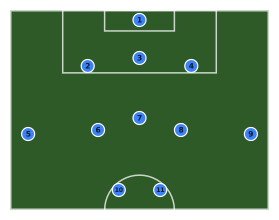
Three centre backs, wing backs pushed high and wide onto the touchlines, a midfield three inside them and a front two. Overloads the middle and asks the wing backs to cover the whole flank.
Read the setup
4-2-3-1
Formation · 11 players
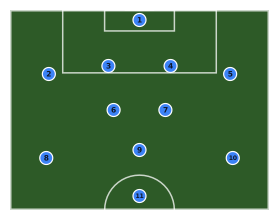
Back four, a double pivot screening in front of them, three attacking midfielders and a lone striker. The modern default: solid through the middle with a number ten between the lines.
Read the setup
4-3-3
Formation · 11 players
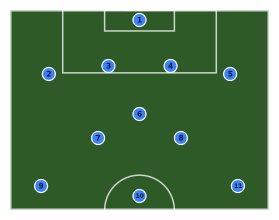
Back four, a single pivot with two eights ahead of them, and a front three holding the width. The wingers sit on the touchlines so the full backs have the space to overlap.
Read the setup
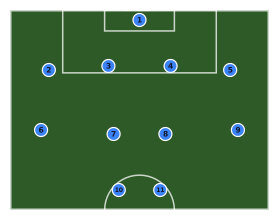
4-4-2
Formation · 11 players
The classic two banks of four with a front pair. Drawn as a mid block defending the goal at the top: back four on the edge of the penalty area, midfield four across the middle third, strikers up on the halfway line.
Read the setup
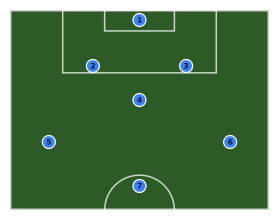
7v7 2-1-2-1
Formation · 7 players
Seven a side as a diamond: two centre backs, one holding midfielder, two wide players and a striker. It teaches the triangles every older shape is made of, and asks the holding player to read the game early.
Read the setup
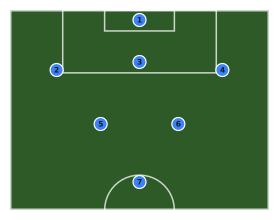
7v7 3-2-1
Formation · 7 players
Seven a side with three at the back, two central midfielders and a striker. The safer shape for a young team that concedes on the counter: a spare defender behind the ball, at the cost of width further up.
Read the setup
Put the 7v7 2-3-1 on a pitch
It opens with the shape already drawn. Move the players your team does differently, drag the runs, and send your squad a link that animates.
Open in PlaymakerPage updated · Soccer play designer · All templates