The 4-2-3-1 and the ten metres behind the ten
Soccer · Formation · 11 of your players
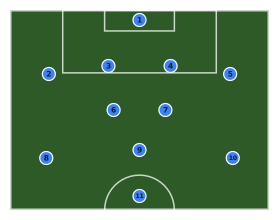
Back four, two holding midfielders side by side, a bank of three attacking midfielders and one striker. The gaps between those four lines are the whole coaching point.
Opens on a soccer pitch with the shape already drawn. Free, no signup.
Four lines, and the distances between them
A flat back four across the edge of the penalty area, with the full backs about ten metres in off each touchline. Two defensive midfielders in front of them, side by side and roughly fourteen metres apart, close enough to pass to each other without looking up. Three attacking midfielders next, the wide pair almost on the touchlines. And one striker, on his own, near the halfway line.
The detail worth noticing is the ten. He is drawn about two metres behind the wide pair, not level with them, and about ten metres ahead of the double pivot — sitting in the seam between an opposition midfield and their back four rather than in either of them. From there to the striker is another twelve metres. That is the space the whole shape is built to attack, and it is also the space the ten has to keep empty until the right moment.
When to set up this way
This is the shape to reach for when you want a solid middle without giving up a creative player. Two holders means one can always follow a runner while the other screens, so you are far less likely to be opened up by a single pass than in a 4-3-3. Against a 4-4-2 the ten stands in the hole between their lines all afternoon and somebody has to decide whose problem he is.
The weakness is the lone striker. If the ten does not join him quickly you are pressing a back four with one player, and the front three ends up chasing rather than pressing.
What to work on at training
- Never both pivots. Move one holder up to the ten's line and hold the other. Then swap. Two coaching pictures, thirty seconds each, and the argument is over.
- The ten's arrival. Draw the striker pulling wide and the ten running through the space he vacates. Animate it — the timing is the play, and a still diagram hides it.
- Full backs make the width. With the wide tens already high, the full backs overlap or underlap. Draw both versions and let your players tell you which they prefer.
Load the 4-2-3-1 on the pitch, drop your ten where your ten actually stands, and put the runs on top.
Also known as
- double pivot
- number ten
- lone striker
- modern
Shapes to look at next
3-5-2
Formation · 11 players
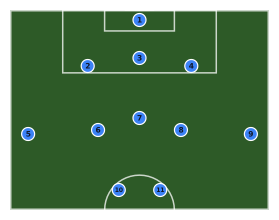
Three centre backs, wing backs pushed high and wide onto the touchlines, a midfield three inside them and a front two. Overloads the middle and asks the wing backs to cover the whole flank.
Read the setup
4-3-3
Formation · 11 players
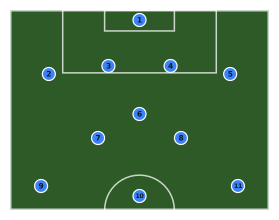
Back four, a single pivot with two eights ahead of them, and a front three holding the width. The wingers sit on the touchlines so the full backs have the space to overlap.
Read the setup
4-4-2
Formation · 11 players
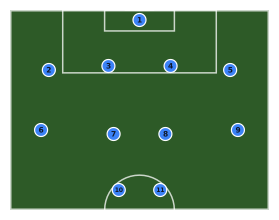
The classic two banks of four with a front pair. Drawn as a mid block defending the goal at the top: back four on the edge of the penalty area, midfield four across the middle third, strikers up on the halfway line.
Read the setup
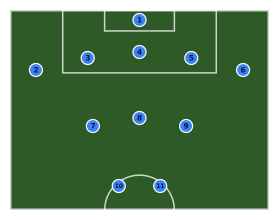
5-3-2 low block
Defence · 11 players
A back five dropped onto the edge of the six-yard box with a midfield three in front and two strikers held back for the counter. What you set up when you are protecting a lead.
Read the setup
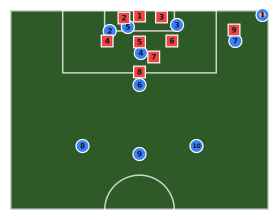
Attacking corner (right)
Set piece · 19 players
A right-side corner: taker on the flag, runners at the near and far post, a target on the penalty spot, a short-corner option and three held back for rest defence. Ten outfield players — the keeper is in the other half, off screen. The nine defenders show a zonal set-up to attack against.
Read the setup
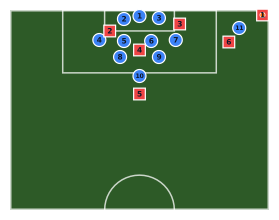
Defending a corner (zonal)
Set piece · 17 players
Zonal corner defence: keeper on his line, bodies on both posts, four across the six-yard line, two on the penalty spot, one on the edge of the box and one out to press the taker. All eleven of ours, against six attackers.
Read the setup
Put the 4-2-3-1 on a pitch
It opens with the shape already drawn. Move the players your team does differently, drag the runs, and send your squad a link that animates.
Open in PlaymakerPage updated · Soccer play designer · All templates