The 9v9 3-3-2, a player in every lane
Soccer · Formation · 9 of your players
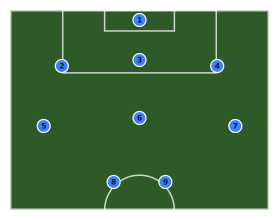
Three at the back, three across midfield and two strikers up front. The steady nine-a-side shape: nobody is outnumbered in the middle, and the front two learn the oldest partnership in the game.
Opens on a soccer pitch with the shape already drawn. Free, no signup.
How the shape works
A back three on the edge of the box, a midfield three spread from touchline to touchline, and two strikers side by side near halfway. Every outfield line has a player in the middle and the back two lines have a player on each side, so every lane of the pitch has an owner from the penalty area to the halfway line.
The 9v9 3-3-2 is the balanced shape. It defends as well as the 3-2-3 at the back, it is never outnumbered in central midfield, and the price is width up front: the two strikers start inside, so the wide midfielders have to get forward to make the pitch big.
What it teaches
- The strike partnership. Two strikers, one job each: one goes in behind, one comes short. Draw both runs on one diagram and animate them, because a pair who both go short, or both go long, is the most common thing that goes wrong in this shape.
- Wide midfielders who arrive. The width in attack comes from the left and right midfielders running past the strikers' shoulders. Drag that run up the touchline.
- A midfield three that slides. When the ball goes wide, the three shift across together, and the far one tucks in. It is the first lesson in defending as a unit.
When to use it
It is a good default for a 9v9 team that is new to the format and still learning to keep its shape, and a good answer to an opponent who plays three in midfield. Against a team that leaves its wide players high, ask the outside centre backs to step into midfield with the ball, which turns the 3-3-2 into something closer to a 2-4-2 for a few seconds and gives you the extra player.
Open the 9v9 3-3-2 in the designer and draw the two strikers' runs together.
Also known as
- youth soccer
- 9v9
- nine a side
- front two
- small sided
Shapes to look at next
3-5-2
Formation · 11 players
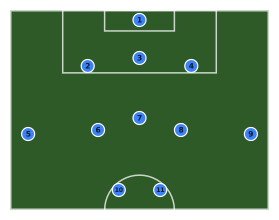
Three centre backs, wing backs pushed high and wide onto the touchlines, a midfield three inside them and a front two. Overloads the middle and asks the wing backs to cover the whole flank.
Read the setup
4-2-3-1
Formation · 11 players
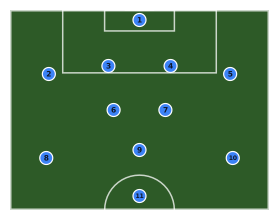
Back four, a double pivot screening in front of them, three attacking midfielders and a lone striker. The modern default: solid through the middle with a number ten between the lines.
Read the setup
4-3-3
Formation · 11 players
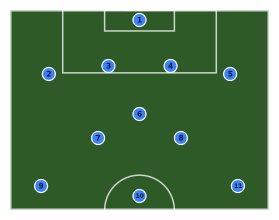
Back four, a single pivot with two eights ahead of them, and a front three holding the width. The wingers sit on the touchlines so the full backs have the space to overlap.
Read the setup
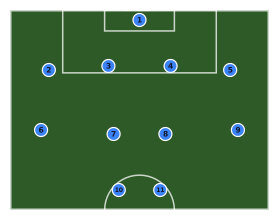
4-4-2
Formation · 11 players
The classic two banks of four with a front pair. Drawn as a mid block defending the goal at the top: back four on the edge of the penalty area, midfield four across the middle third, strikers up on the halfway line.
Read the setup
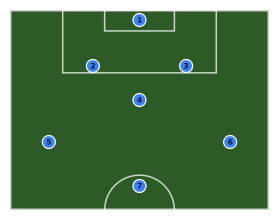
7v7 2-1-2-1
Formation · 7 players
Seven a side as a diamond: two centre backs, one holding midfielder, two wide players and a striker. It teaches the triangles every older shape is made of, and asks the holding player to read the game early.
Read the setup
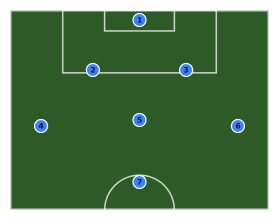
7v7 2-3-1
Formation · 7 players
Seven a side: a keeper, two centre backs, a midfield three across the pitch and one striker. The most common 7v7 shape, because every player has a clear lane and nobody is left alone at the back.
Read the setup
Put the 9v9 3-3-2 on a pitch
It opens with the shape already drawn. Move the players your team does differently, drag the runs, and send your squad a link that animates.
Open in PlaymakerPage updated · Soccer play designer · All templates