Defending the short corner, with the attack drawn in
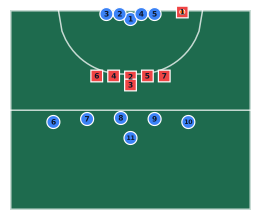
Field hockey · Set piece · 11 of your players and 7 opponents
Goalkeeper and four defenders on the goal line, six teammates held back, and seven opposition attackers set up on the circle. The picture your defenders see for two seconds.
Opens on a field hockey pitch with the shape already drawn. Free, no signup.
The legal set, position by position
Eighteen players are on this pitch: your eleven and seven of theirs, drawn as squares so nobody confuses the two. The goalkeeper is in the goal. Four defenders are on the goal line — the first runner just inside the left post, a defender covering each post, and a fourth wider on the right. Those five are all you are allowed near the goal: the FIH Rules of Hockey (13.3) allow no more than five defenders, keeper included, behind the back-line, and the other six must be beyond the centre line until the ball is played. Not the 23 m line: the centre line, a whole half away. The pitch shows only your half, so the six are drawn on the centre line at the far edge, the nearest the picture gets to where they really stand.
Opposite them, the attacking set: injector on the backline, trapper and striker at the top of the D, both slips and both post runners outside the circle. That is the point of this template over a blank pitch — you are not drawing your defence in the abstract, you are drawing it against the thing it has to stop.
When you will be defending one
Most weeks, several times, usually when you are ahead and tired. The four on the line have one shared job and four different ones. The first runner attacks the trap and has to arrive before the flicker can lift; the two post defenders stop the deflection and the rebound; the fourth covers the ball that squirts wide and the slip nobody picked up.
The six beyond the centre line matter more than they look. They are your counter-attack, and they are also your second line if the corner is recycled, which is where most corners are actually scored from — not the first shot but the reset.
Rehearsing it
- Race the first runner. Draw them charging and animate it against the attacker's release. If they are still five metres away when the flick goes, they left too late or they ran at the wrong shoulder.
- Pick one variation and defend it. Move the opposition slip in front of the striker, then decide which of your four reacts. Doing that four times is a better session than shouting about concentration.
- Where the six arrive. They cannot cross the centre line until the ball is played, so they start 45 m from your goal. Drag them back towards the circle once the ball is injected and see how far they get before the reset. A clearance to nobody is a second corner.
Bring it into the designer, replace their set-up with the one your next opponent runs, then animate your first runner against it and see who wins.
Compare all field hockey formations
Also known as
- penalty corner
- short corner
- set piece
- first runner
- defending
Shapes to look at next
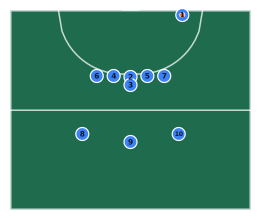
Penalty corner attack
Set piece · 10 players
The injector on the backline 10 m from the post, with the trapper, striker, both slips and both post runners lined up on the edge of the shooting circle — every attacker but the injector has to start outside the circle, and these do. Ten outfield players; the keeper is back in your own half, off screen.
Read the setup
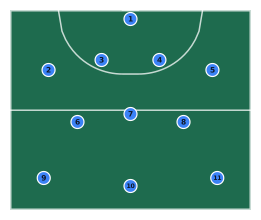
4-3-3
Formation · 11 players
Field hockey’s workhorse shape: a back four, three through the middle and a front three holding the width. Drawn defending the goal at the top, with the forwards up on the halfway line.
Read the setup
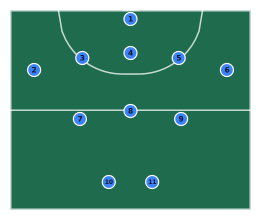
5-3-2
Formation · 11 players
Five across the back with three in midfield and two forwards. The extra defender covers the width of the pitch and lets the outside backs join the attack one at a time.
Read the setup
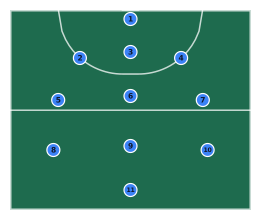
3-3-3-1
Formation · 11 players
The Dutch structure — three lines of three behind a single striker. Short passing distances in every direction, which is what makes it the shape most possession-based hockey is coached from.
Read the setup
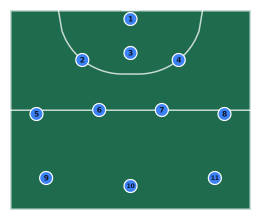
3-4-3
Formation · 11 players
Three at the back, four across midfield stretched to both sidelines and a front three. Attacking by default: the wide midfielders give you five in the front line whenever you have the ball.
Read the setup
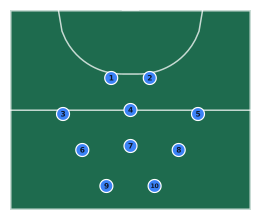
Full press (2-3-3-2)
Defence · 10 players
Pressing high in the opposition half: two on the circle edge forcing the outlet, three behind them, three across midfield and two holding. Ten outfield players — a full press leaves the keeper in your own half, off screen.
Read the setup
Put the Penalty corner defence on a pitch
It opens with the shape already drawn. Move the players your team does differently, drag the runs, and send your squad a link that animates.
Open in PlaymakerPage updated · Field hockey play designer · All templates