Field hockey practice plan template
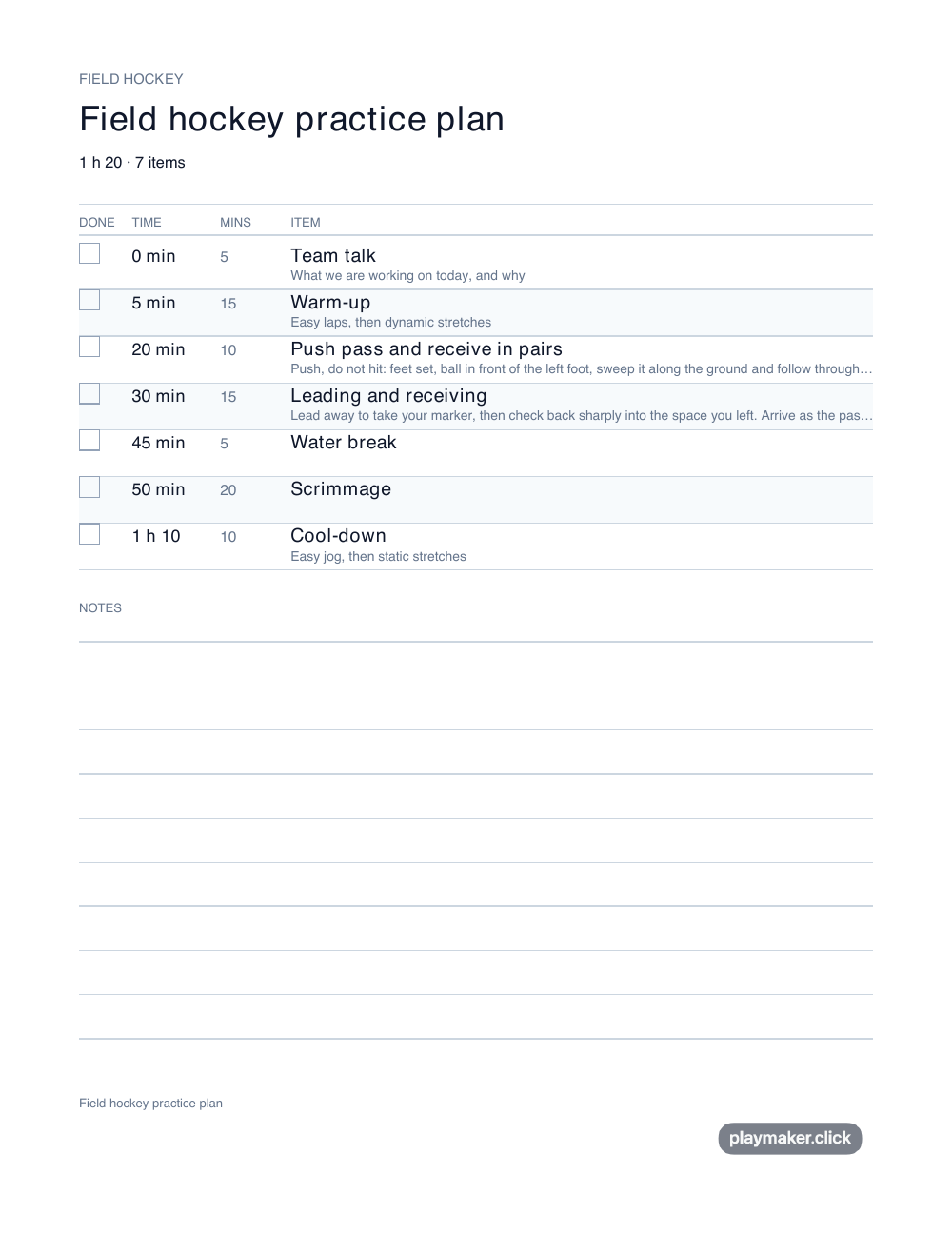
A one-page field hockey practice plan with a start time beside every block. Team talk, warm-up, push pass and receive in pairs, leading and receiving, a water break, a scrimmage and a cool-down, ready to print and take to the pitch.
Free, no account, nothing to install. Field hockey practice plan, US Letter. Edit opens the practice plan maker on the same field hockey plan.
How to use this template
Print it for the pitch
Print on US Letter or A4. One page on a clipboard, so nothing flips over on a windy turf.
Lay the cones before the bell
The pairs drill needs gates ten metres apart and the leading drill a grid around the passer. Put them out first and the session starts on time.
Tick each block as you go
A tick beside each block tells you and your assistant where you are without checking the clock, so the game is not the block that gets cut.
Write down the fouls
Use the notes lines for back sticks, raised balls and players standing still to receive. That is the drill for next week.
Download the template
Would rather type than write? The free practice plan maker makes the same sheet from what you type.
Turf time is booked by the hour
Most field hockey teams share a turf, and the next team is waiting at the gate when your hour is up. A list of drills does not tell you that the passing has run long and the game is about to be cut. A plan with a start time beside every block shows you at a glance, with time left to decide what to drop.
So this template is a run sheet. Each block has its length and the minute it starts, counted from the first whistle, with a tick box to mark it done and the coaching cue printed under each drill. It prints on one page, with lines at the foot for notes.
What is in the plan
It is the plan the practice plan maker opens on for field hockey:
- a five-minute team talk;
- a fifteen-minute warm-up of easy laps and dynamic stretches;
- push pass and receive in pairs, a flat push pass that stays on the ground and a receive that takes the pace off it, on the open side and then the reverse;
- leading and receiving, a lead away to take the marker, then a sharp check back into the space, arriving as the pass is made;
- a water break;
- a twenty-minute scrimmage;
- a cool-down.
It runs eighty minutes. For a one-hour turf slot, shorten the warm-up and the scrimmage by ten minutes between them, and the start times on the sheet still tell you where you should be.
The cues that matter in field hockey
Most of the ball a junior team gives away is lost on the first touch, so the pairs drill comes first. The cue is push, do not hit: feet set, the ball swept along the ground to the target, and a receive with soft hands and the stick low and angled over the ball. Every reverse-side receive is made with the stick turned over, because the ball may only be played with the flat face and the edges of the stick, and playing it with the rounded back is a foul. A push along the ground also never breaks the rule against a dangerously raised ball.
Leading is the legal answer to obstruction. A player standing with their back to an opponent who is trying to play the ball, shielding it, gives away a free hit. A player who leads away and checks back into the space arrives free, side-on, and able to see the pitch. Junior formats such as Rush Hockey, Hookin2Hockey and 7-a-side add their own limits on hitting and lifting the ball, so check your association's rules for your age group.
Changing it
On paper, cross a drill out and write yours beside it, keeping its minutes so the later start times still hold. On screen, the edit button opens the practice plan maker with this plan loaded. Swap either drill for any of the field hockey drills in the library, such as the give-and-go or the penalty corner, change the minutes, and print it again with every start time worked out. It is free and needs no account.
For match day, the rotation maker for field hockey shares out the playing time fairly across your squad and prints the substitutions on one page.
Common questions
What should a field hockey practice plan include?
A team talk, a warm-up, a passing and receiving drill, a drill on the skill you are teaching, a water break, a game that puts it under pressure, and a cool-down. This template has all of them, timed, with the drills' coaching cues printed under them.
How long should a youth field hockey practice be?
An hour to ninety minutes for most youth and club teams, and often whatever the turf booking allows. Keep each drill to ten or fifteen minutes for younger players. This plan runs eighty minutes.
Why is the push pass taught before the hit?
Because it is accurate, it stays on the ground, and a young player can make it from a standing start without a backswing. It is the pass most of a game is played with, and it cannot raise the ball dangerously, so it is the safe one to learn first.
Is this field hockey practice plan template free?
Yes. Download and print it as often as you like, with no account and no email address. It carries a small Playmaker mark at the foot of the page.
Can I make a practice plan for another sport?
Yes. There are printable practice plan templates for eight sports, and the practice plan maker builds a timed plan for any of them from its drill library or your own blocks.
More free printable templates
- Football wristband template
- Flag football wristband template
- Football call sheet template
- Soccer practice plan template
- Basketball practice plan template
- Football practice plan template
- Netball practice plan template
- Volleyball practice plan template
- Rugby practice plan template
- Baseball practice plan template
- Volleyball rotation sheet
- Youth soccer rotation template
Fill it in on screen instead
The free practice plan maker opens on this template. Type instead of writing, print as many copies as you need, and change it next week without starting again.
Edit this in PlaymakerPage updated · All templates