Netball set plays, every centre pass and throw-in on one page
Each set play is drawn to scale on the full court, all three thirds, with a line on when to use it and a page on how it works. Compare them here, then open the one you want and draw the leads your team makes from it.
Free, no account, nothing to install.
Centre pass attack
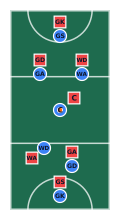
Centre pass set-up
Formation · 14 players
Before every other centre pass drill. Walk the squad onto these spots so everyone starts legal, then draw the first lead off them.
Read the setup
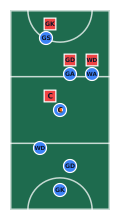
Centre pass overload right
Attack · 11 players
When their goal defence and wing defence mark tight. Crowd them into one channel, then let the goal attack re-cut into the empty left side.
Read the setup
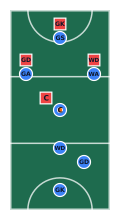
Centre pass split lead
Attack · 11 players
When their defenders like to help each other. Two leads more than 10 m apart cannot both be covered, and the wing defence is the safe ball back.
Read the setup
How the centre passes compare
Who the centre is looking for first, how many players lead for the ball, and where each set-up leaves the space. Every one is a starting point: the leads your players make are yours to draw.
| Centre pass | First pass to | The leads | Where the space is | The risk |
|---|---|---|---|---|
| Centre pass set-up | First pass to: Whoever leads first, GA or WA, from the attacking transverse line | The leads: GA and WA, 6.4 m apart on the transverse line | Where the space is: The centre third in front of them, where the first pass must be caught | The risk: A GA or WA who drifts into the centre third before the whistle gives the other team a free pass |
| Centre pass overload right | First pass to: GA or WA, whichever goes first, using the other as a screen | The leads: Two, side by side on the right of the transverse line, with GS drifted left | Where the space is: The empty left side of the centre third, for the GA's re-cut | The risk: The re-cut only works if GA waits for the defence to commit |
| Centre pass split lead | First pass to: GA on the left or WA on the right, with WD in the middle as the ball back | The leads: Two, more than 10 m apart, so their defenders cannot help each other | Where the space is: Whichever side their GD or centre leaves when they cheat across to help | The risk: Both front leads denied, so the pass back to WD has to be the plan, not the failure |
Defending their centre pass
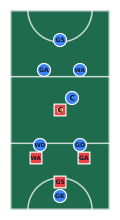
Throw-ins
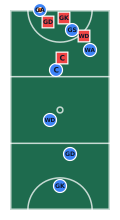
Attacking backline throw-in
Set piece · 11 players
The ball is out over the goal line you attack. Goal attack throws beside the post, and the shooter on the far side of the ring is the first look.
Read the setup
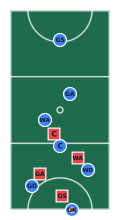
Defensive backline throw-in
Set piece · 11 players
A missed shot has gone out over your own goal line. The goal keeper throws, the goal defence and wing defence go wide, and the ball is out of the defending third in two passes.
Read the setup
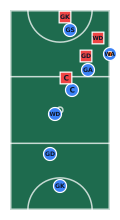
Sideline throw-in, attacking third
Set piece · 11 players
A throw-in from the side line near their circle. Goal attack leads at the thrower, the goal shooter waits for the second ball, and the centre is the reset.
Read the setup
How the throw-ins compare
Who takes the throw, from which third, where the first ball goes and where the safe ball is if it is covered.
| Throw-in | Who throws | Which third | First option | The safe ball | The risk |
|---|---|---|---|---|---|
| Attacking backline throw-in | Who throws: GA, on the goal line beside the post | Which third: Attacking, from the goal line | First option: GS on the far side of the ring, then WA on the circle edge | The safe ball: C, high, about 9 m from the goal line | The risk: Every defender is crammed into the circle, and the thrower has three seconds |
| Defensive backline throw-in | Who throws: GK, on the goal line we defend | Which third: Defending, from the goal line | First option: GD breaking for the side line, or WD on the circle edge | The safe ball: C, holding the defending transverse line | The risk: A turnover here costs a goal, and their GS and GA are closest to the post |
| Sideline throw-in, attacking third | Who throws: WA, on the right side line | Which third: Attacking, from the side line | First option: GA, leading hard at the thrower, then GS for the second ball | The safe ball: C, near the attacking transverse line | The risk: Forcing a pass into a crowded circle instead of resetting through the centre |
What a netball set play is
Netball has no formations in the way soccer or basketball does, because the rules have already decided where everyone may go. Each of the seven positions is allowed in only part of the court, only the goal shooter and goal attack may enter the goal circle you attack, and at the whistle every player but the two centres waits in a goal third. What a coach decides is the set play: who leads, in what order, and where the second and third passes go.
There are two moments in a game when everyone stops and the play can be set. The first is the centre pass, which alternates between the teams whoever scored, so your side takes one after every other goal. The second is the throw-in, from the side line or the goal line, when the ball has gone out of court and the thrower has three seconds to get rid of it while her defender stands at least 0.9 m away. Every play on this page starts from one of those two moments.
Picking set plays for a junior team
Start with the centre pass set-up. It is not a play at all: it is all fourteen players where the rules put them, and a junior team that can find those spots without being told has stopped giving away free passes before the game has started. Draw one lead off it, play it back, and talk about who goes first.
Add the split lead next. Its one idea, that two leads a court apart cannot both be covered, is easy to see in a diagram, and it teaches the wing defence that the ball back to her is a good outcome rather than a failure. The overload asks more: two attackers who can time their leads off each other, and a goal attack patient enough to wait for the re-cut.
For throw-ins, teach the defensive backline first. A missed shot that goes out over the goal line puts your team there, and getting out of the defending third in two passes is what stops a missed shot at one end becoming a goal at the other. For two centre pass routines animated in the page, read the netball centre pass set plays guide, and for three backline plays, the netball backline throw-in plays guide.
Netball set plays: common questions
Where do players stand at a netball centre pass?
The centre taking the pass stands in the centre circle with the ball. The opposing centre may stand anywhere in the centre third. Every other player waits in a goal third until the whistle, and the first pass has to be caught in the centre third.
What is a split centre pass in netball?
A centre pass where the goal attack and wing attack start at opposite ends of the transverse line, more than 10 m apart, so their defenders cannot help each other. The centre has two first-pass targets, and the wing defence in the middle of the defending transverse line is the safe ball back if both are covered.
How do you defend a netball centre pass?
Front the leads. The wing defence and goal defence stand on the ball side of the players they mark, right on the transverse line, so the easy straight lead is gone and the first pass has to go long, wide or backwards. The goal keeper stays goal-side of their shooter, and the centre is free to pick up the pass that does get thrown.
Who takes a backline throw-in in netball?
A player who is allowed in that part of the court. In these set plays the goal attack takes it at the end you attack, beside the post, and the goal keeper takes it at the end you defend. Either way the thrower has three seconds, and the nearest defender must stand at least 0.9 m away.
Can I change a set play after I open it?
Yes. Every set play opens on the full court as a starting picture. Drag any player to a new spot, draw the leads and the passes, press play to watch it move, and send your team the link. It is free and you do not need an account.
Draw your own set play
Open a netball court, put your seven in their bibs, draw the leads and the passes and press play. Free, and you do not need an account.
Open a netball courtPage updated · Netball play designer · All netball templates