The 5-out, with the lane completely empty
Basketball · Attack · 5 of your players
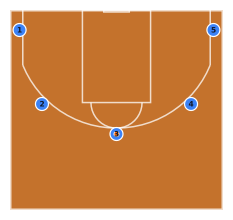
All five players stand outside the three-point line, so there is no help defender anywhere near the rim. Everything good about this offence comes from keeping it that way for a whole possession.
Opens on a basketball pitch with the shape already drawn. Free, no signup.
Five on the arc, nobody inside
Two shooters in the deep corners, a wing on each side above the free-throw line extended, and the ball at the top of the key. Every one of the five is beyond the three-point line, and the entire area from the free-throw line to the rim is unoccupied.
That empty space is the offence. A defender who wants to help on a drive has to leave a shooter to do it, and he has to come a long way, which means the first player to attack the rim is attacking one defender rather than two. It is also why the corners in this shape are drawn tight to the sideline and level with the rim: a corner three sits closer to the ring than a shot from the wing, so the corner is where you want the kick-out to land.
Who should be running it
This is the alignment most youth programmes should start from, because it teaches driving, cutting and passing without asking a twelve-year-old to understand post play first. It also works at the other end of the game, for a senior side with five players who can all put the ball on the floor.
The cost is honest and worth stating. There is nobody near the rim when the shot goes up, so your offensive rebounding is whoever ran back to get it. Against pressure, five players on the perimeter are five players who can be denied at once, which is why the backdoor cut is part of the offence rather than an option in it.
Three things that break it
- A player drifting into the lane. Draw one wing two steps inside the arc and the drive you were setting up now has a second defender in it. This is the defect to look for on every diagram you make.
- Cutting without replacing. Send the left wing through to the basket and mark who fills the space behind him. If nobody does, the spacing collapsed the moment the ball moved.
- A pass and a stand. Animate a pass from the top to the right wing with the passer frozen. Watching it once explains more about ball movement than a week of telling.
Open 5-out in the designer, draw the drive and the two relocations you want off it, then share the animation with the group before the next session.
Also known as
- motion offence
- spacing
- five out
- drive and kick
Shapes to look at next
4-out 1-in
Attack · 5 players
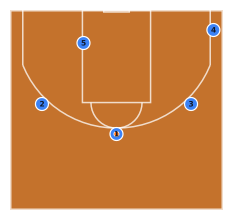
Four players spaced around the arc with one post on the left block. Keeps a genuine inside threat while leaving three-quarters of the floor open for perimeter action.
Read the setup
High pick and roll
Attack · 5 players
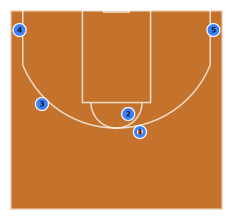
Ball handler above the arc on the right with the screener stepping up to meet him, both corners filled and the weak-side wing lifted. The three spacers keep help defenders a pass away from the roll.
Read the setup
Horns
Attack · 5 players
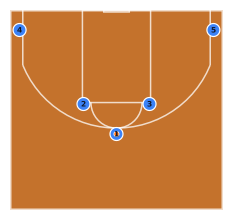
Two bigs at the elbows, two shooters in the corners, the ball at the top of the key. Every horns action — the double drag, the flare, the elbow entry — starts from exactly this picture.
Read the setup
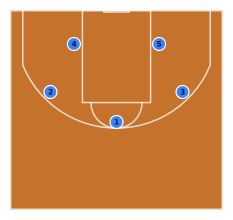
1-2-2 zone
Defence · 5 players
One up top, two on the wings and two low. Pressures the ball higher than a 2-3 and invites the pass into the middle, where the two low defenders are waiting.
Read the setup
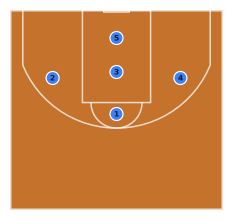
1-3-1 zone
Defence · 5 players
One at the point, three across the middle — two wings plus a defender in the heart of the lane — and one on the baseline. Traps hard in the corners and takes away the high post.
Read the setup
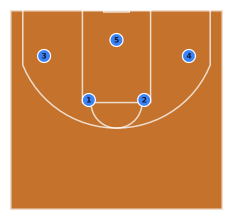
2-3 zone
Defence · 5 players
Two guards at the free-throw line extended over three across the baseline. Protects the paint and the boards, and asks the offence to beat it from outside.
Read the setup
Put the 5-out on a pitch
It opens with the shape already drawn. Move the players your team does differently, drag the runs, and send your squad a link that animates.
Open in PlaymakerPage updated · Basketball play designer · All templates