Horns, the starting picture for a dozen plays
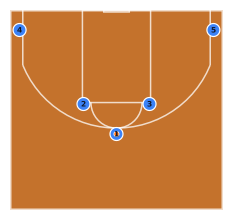
Basketball · Attack · 5 of your players
Perfect symmetry on purpose: a big on each elbow, a shooter in each corner, and the ball at the top of the key. Nothing about the alignment tells the defence which side the play is going.
Opens on a basketball pitch with the shape already drawn. Free, no signup.
Two elbows, two corners, one ball
The point guard has the ball at the top of the key. A big stands on each elbow, where the free-throw line meets the edge of the lane. A shooter waits in each deep corner. Five players, and the lane between them is empty from the free-throw line to the rim.
The symmetry is the value. Both elbow players are a legal screen for the ball, both corners are a catch-and-shoot away from the pass out, and neither side of the floor has been declared yet, so the defence cannot load up before the first action. Everything about this shape is a question the defence has to answer after the play has begun rather than before.
The actions it opens
Two bigs at the elbows means two screens available on the same dribble, which is the double drag: the handler takes the first, the second steps up behind it, and the second screener either rolls or spaces out behind the arc. Pass to one elbow instead and you have an elbow entry, with the other big cutting off the catch or screening away for the corner shooter. Refuse both and there is still the flare, where the corner comes up and one elbow big sets a screen across the top for a shot the defence has already turned away from.
Use horns when you need a set that gives you three options from one entry, which is what a timeout should buy you. Use something with more movement when the elbows are guarded by players quick enough to reach the corners.
What to put on the practice plan
- Which big screens first, and why. Draw the double drag both ways. The order matters: the second screener is the one who ends up open above the arc.
- The corner does not stand there. Give the ball-side shooter a lift as the ball comes toward him. The corner is a starting spot, not a place to spend a possession.
- The counter on a switch. Draw the second picture — everyone where they are when the first screen has been switched. A set play with no counter is a set play that works once.
Start from horns in the designer and draw the one entry your team actually runs well, then add the counter underneath it.
Also known as
- horns
- elbows
- ball screen
- set play
Shapes to look at next
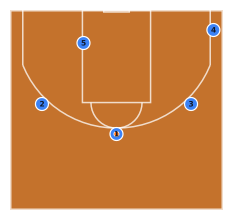
4-out 1-in
Attack · 5 players
Four players spaced around the arc with one post on the left block. Keeps a genuine inside threat while leaving three-quarters of the floor open for perimeter action.
Read the setup
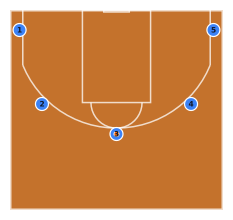
5-out
Attack · 5 players
All five outside the three-point line — both corners, both wings and the top of the key — so the lane is completely empty to drive or cut into. The spacing motion offence most youth programmes start with.
Read the setup
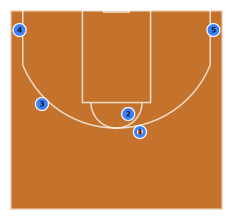
High pick and roll
Attack · 5 players
Ball handler above the arc on the right with the screener stepping up to meet him, both corners filled and the weak-side wing lifted. The three spacers keep help defenders a pass away from the roll.
Read the setup
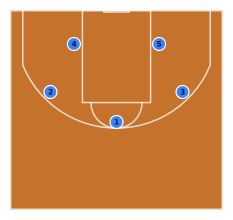
1-2-2 zone
Defence · 5 players
One up top, two on the wings and two low. Pressures the ball higher than a 2-3 and invites the pass into the middle, where the two low defenders are waiting.
Read the setup
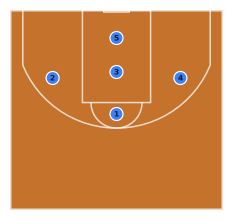
1-3-1 zone
Defence · 5 players
One at the point, three across the middle — two wings plus a defender in the heart of the lane — and one on the baseline. Traps hard in the corners and takes away the high post.
Read the setup
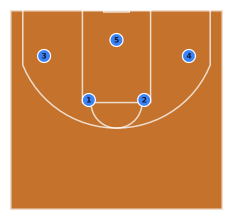
2-3 zone
Defence · 5 players
Two guards at the free-throw line extended over three across the baseline. Protects the paint and the boards, and asks the offence to beat it from outside.
Read the setup
Put the Horns on a pitch
It opens with the shape already drawn. Move the players your team does differently, drag the runs, and send your squad a link that animates.
Open in PlaymakerPage updated · Basketball play designer · All templates