Rugby set plays, every set piece and shape on one page
Each one is drawn to scale on a half pitch with the 22 m and 10 m lines where the laws put them, with a line on when to use it and a page on how it works. Compare them here, then open the one you want and draw the move your team runs off it.
Free, no account, nothing to install.
Set pieces and restarts
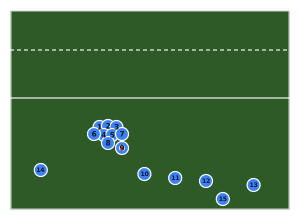
Attacking backline from a scrum
Attack · 15 players
A set scrum with a settled defence in front of you. Nothing else in the game gives you as much control over where all fifteen start, so it is the platform for a strike move.
Read the setup
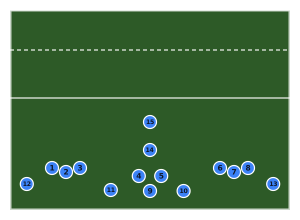
Kick-off receive
Set piece · 15 players
Their restart, when you do not yet know what their kicker does. Two pods and a pair for the contested ball, and the fullback and outside centre covering the long kick.
Read the setup
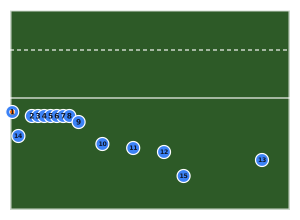
Lineout (7-man)
Set piece · 15 players
Inside your own half when you want the ball without a gamble. Seven in the line gives you three lifting pods, a maul and a peel, and it is the line to keep when your throw is under pressure.
Read the setup
How the set pieces compare
Who wins the ball, where the backs stand while it is won, the first-phase option it sets up, and what goes wrong. Every one is a starting point: the move your team runs off it is yours to draw.
| Set piece | Who wins the ball | Where the backs stand | First-phase option | The risk |
|---|---|---|---|---|
| Attacking backline from a scrum | Who wins the ball: Your eight, bound in, with the number 8 at the base and the scrum-half at the number 8's feet on the open side | Where the backs stand: Fanned to the open side: the fly-half 10 m off the gain line, then the centres and right wing about 8 m apart, each a metre deeper | First-phase option: A strike move into some 45 m of open side, with the fullback entering outside the outside centre | The risk: A scrum going backwards moves the gain line with it, and the fly-half's 10 m becomes 7 |
| Kick-off receive | Who wins the ball: The pod you call: two pods of three out wide, each with a lifter, and a pair in the middle | Where the backs stand: The halves in front of the pods for the short kick, the wings on the touchlines, the outside centre and the fullback deep for the long one | First-phase option: The catch, then the first forward from the nearest pod to the catcher, and the ruck you either win or lose | The risk: The corridor between the wing and the fullback on a long kick to the corner, if nobody talks to the fullback |
| Lineout (7-man) | Who wins the ball: A jumper in one of three lifting pods, from the hooker's throw on the touchline | Where the backs stand: Stacked rather than flat, and at least 10 m back until the lineout ends: the fly-half outside the 15 m line, the centres stepping out, the fullback deep | First-phase option: A maul, the tail peeling round the front, or off the top to the scrum-half just outside the 15 m line | The risk: Seven in the line keeps seven defenders in it, and a fly-half too close to the line plays the move standing still |
Attacking shape
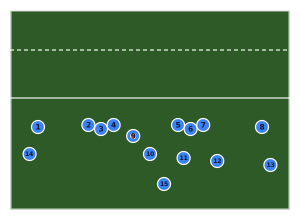
Defence
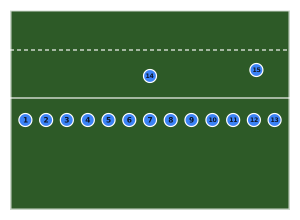
Defensive line (13 up, 2 back)
Defence · 15 players
A neutral phase in the middle of the park, with no ruck to fold around yet. The shape you fold back into after a scramble.
Read the setup
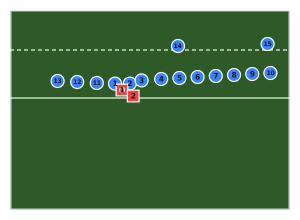
Ruck defence: pillar and post
Defence · 17 players
Their second and third phase inside your own 22, when they are going through the middle looking for a soft edge. Pillars and post first, then everybody else.
Read the setup
How the defences compare
Who stands in the line, how far apart, who covers the back field, and where each one gets beaten.
| Defence | In the line | Spacing | The back field | The risk |
|---|---|---|---|---|
| Defensive line (13 up, 2 back) | In the line: Thirteen across the full width, the widest about 4 m off each touchline | Spacing: About 5 m, close enough for two to squeeze a carrier and wide enough for thirteen to cover 70 m | The back field: Two: the fullback sweeping in the middle and a winger on the right | The risk: Spacing that drifts: at 7 m there is a hole in every gap, at 3 m the outside is empty |
| Ruck defence: pillar and post | In the line: Two pillars either side of the ruck, the post 3 m wider, seven on the open side, three on the blind | Spacing: Pillars less than 2 m off the ruck, then about 4.5 m across the open side, staggered deeper towards the wing | The back field: Two: the fullback and a winger, sweeping deep | The risk: A pick-and-go at a pillar who arrived last, and a blindside that is three on paper and one on the day |
What a rugby set play is
Rugby union has no formation in the way soccer has: nobody lines up in a 4-4-2 and stays there. What a coach draws is the picture at the moments the game stops and restarts, and the shape the team keeps between them. The lineout, the scrum and the kick-off are the set pieces, where the laws decide who stands where and both sides are set. The pods are how you attack once the ball is moving, and the defensive line and the ruck defence are how you stop the other side doing the same.
The laws are why a set piece is worth drawing to scale. At a lineout the forwards stand between the 5 m and 15 m lines, and everyone not in it stays at least 10 m back from the mark of touch until it ends (Law 18): that 10 m is the space your backs attack. At a scrum the backs need only stand 5 m behind the hindmost foot, so a scrum move has half the room. A kick-off has to reach the 10 m line, and the side receiving it waits on or behind that line until it is kicked (Law 12). A whiteboard has none of those lines, which is why the numbers are worth knowing before you draw.
Picking set plays for a junior team
Start with the seven-man lineout. Most junior sides spend more time getting the lineout organised than running anything off it, and a drawing with the 5 m and 15 m lines on it settles where everybody stands before the first throw. Many age-grade codes play uncontested lineouts with no lifting, so check your union's rules first; the shape works without a lift, and the throw simply goes lower.
Add the defensive line next. Thirteen in the line and two back is the picture every other defensive drill folds back into, and five metres between defenders is a number a young player can see on a diagram and pace out on the pitch. The pillar and post comes after that, once the team is rucking. The pods ask the most: forwards who carry in threes, and halves happy to play what is in front of them. For two lineout moves drawn to the law, read the rugby lineout moves guide, and for the restart from both sides, the rugby kick-off plays guide.
Rugby set plays: common questions
Where do the forwards stand in a lineout?
Between the 5 m and 15 m lines, in a single line half a metre from the mark of touch, with the hooker throwing from the touchline. In the seven-man lineout the order is front jumper and lifter, middle jumper and lifter, back lifter and back jumper, then the tail. Everyone not in the lineout stays at least 10 m back from the mark of touch until it ends.
What does 1-3-3-1 mean in rugby?
It is a width map of the eight forwards, read across the pitch rather than back from the ball: one forward in the left 15 m channel, a pod of three, a second pod of three, and one forward in the right channel. Wherever the next ruck forms, there is already a pod on both sides of it.
How far apart should defenders stand in rugby?
About 5 m in a line from a phase in the middle of the park. That is close enough for two defenders to squeeze a carrier and wide enough for thirteen to cover 70 m, with the fullback and a winger in the back field behind them.
What are the pillars and the post in ruck defence?
The pillars are the two defenders either side of the ruck, less than two metres off it, and the post is the next defender out. They are the first jobs filled, whoever arrives, because a pick-and-go at a soft pillar is where tries are conceded a metre from the breakdown.
How deep should the fly-half stand off a scrum?
In this backline, 10 m off the gain line, with the centres and wing about 8 m apart and each a metre deeper than the last. That depth buys the time for a pass to travel and still be caught running forward. If your scrum goes backwards, stand a metre deeper.
Can I change a set play after I open it?
Yes. Every set play opens on the pitch as a starting picture. Drag any player to a new spot, draw the runs and the passes, press play to watch it move, and send your team the link. It is free and you do not need an account.
Draw your own set play
Open a rugby pitch, place your fifteen, draw the lines of running and the passes and press play. Free, and you do not need an account.
Open a rugby pitchPage updated · Rugby play designer · All rugby templates