Thirteen in the line, two in the back field
Rugby · Defence · 15 of your players
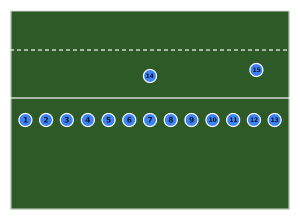
The shape every rugby side defends from and almost nobody draws: thirteen across the full width at real spacing, with two players covering everything kicked in behind.
Opens on a rugby pitch with the shape already drawn. Free, no signup.
Thirteen across, two behind
Thirteen defenders stand on one line about 27 m out from the try line, the widest of them roughly 4 m off each touchline and every gap between them about 5 m. Behind, the fullback sweeps in the middle of the pitch and a winger holds the back field on the right, both of them between the 10 m and 22 m marks — around 11 m and 12 m behind the front line respectively.
Five metres is the number worth staring at. It is close enough that two defenders can squeeze a carrier and wide enough that thirteen bodies genuinely cover 70 m. Draw the same thirteen at 7 m and the line reaches the touchline with room to spare and a hole in every gap; draw them at 3 m and the shape is a wall in midfield with fifteen metres of untouched grass outside it. Coaches say "spread" and "connect" to mean these two failures, and the diagram is where the words get a distance attached to them.
The phase this picture is for
This is the neutral phase — ball in the middle third, no ruck to fold around yet, nobody in the sin bin. It is the shape you fold back into after a scramble, so it is worth being the first picture a new player sees rather than the last.
Take a body out and the maths changes immediately. Fourteen fit players cannot hold 5 m spacing across the field and still keep two back, and this is the drawing where you decide which of those two things you give up. Most sides shorten the blindside; some bring the sweeper up and accept the kick.
What to drill on Tuesday
- Own your gap, not your man. Number the thirteen and hand each player the space to their outside shoulder, then animate one drift so they see the gap move with them.
- Two back, always. Drag the fullback into the line and play it through — the picture of an empty back field is more persuasive than the phrase.
- The widest defender is a decision. Whether your winger stays up or drops is the argument of the season. Draw both versions, save both, and let the squad see which one covers the chip.
Open it in the designer, set the spacing your team can actually hold, then draw the opposition's attack over the top and see whether the line survives it.
Also known as
- defence
- defensive line
- spacing
- back field
Shapes to look at next
Ruck defence: pillar and post
Rugby · Defence · 17 players
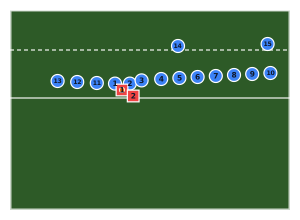
Defending a ruck: two pillars either side of it, the post defender next out, then seven spread across the open side and three covering the blind, with the fullback and a winger sweeping. Gets the two jobs nobody volunteers for filled first.
Read the setup
Attacking backline from a scrum
Rugby · Attack · 15 players
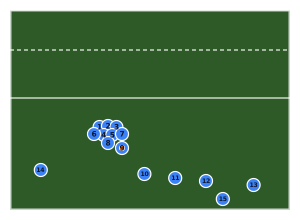
A full fifteen: eight bound into the scrum, the scrum-half at the base, and the backline fanned out to the open side roughly 8 m apart with the fly-half 10 m off the gain line. The blindside winger and fullback cover behind.
Read the setup
Attacking pods (1-3-3-1)
Rugby · Attack · 15 players
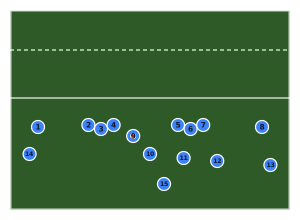
The forwards distributed across the field as one, three, three and one: a forward in each 15 m channel and two pods of three between them, with the halves, centres and back three in behind. Note the digits count players *across* the pitch, not lines of depth — 1-3-3-1 is a width map, which is exactly why it keeps a pod available on both sides of every ruck.
Read the setup
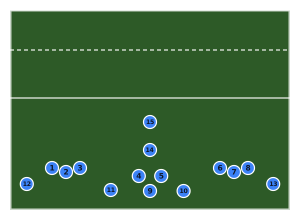
Kick-off receive
Rugby · Set piece · 15 players
Receiving the restart: the forwards in two pods of three with a pair in the middle, all standing at least 10 m back from halfway where the ball has to land, the halves behind them and the outside centre and fullback covering the deep kick.
Read the setup
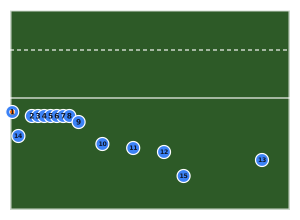
Lineout (7-man)
Rugby · Set piece · 15 players
Seven forwards formed between the 5 m and 15 m lines with the hooker throwing from the touchline, the scrum-half receiving just outside the 15 m line and the backs stacked behind. Where the whole line stands is the bit coaches get wrong on a whiteboard, so it is drawn to the marks.
Read the setup
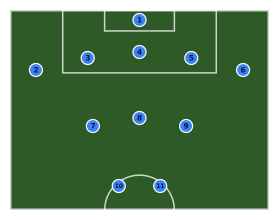
5-3-2 low block
Soccer · Defence · 11 players
A back five dropped onto the edge of the six-yard box with a midfield three in front and two strikers held back for the counter. What you set up when you are protecting a lead.
Read the setup
Put the Defensive line (13 up, 2 back) on a pitch
It opens with the shape already drawn. Move the players your team does differently, drag the runs, and send your squad a link that animates.
Open in PlaymakerPage updated · Rugby play designer · All templates