Rotate towards the attack
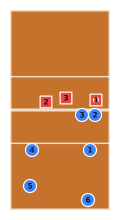
Volleyball · Defence · 6 of your players and 3 opponents
The same double block on their outside hitter, but the back row turns towards it: the right back moves up behind the block for the tip, the middle back slides to the line and the left back covers the deep angle.
Opens on a volleyball pitch with the shape already drawn. Free, no signup.
Who stands where
Rotation defence starts from the same attack as perimeter defence: their outside hitter is swinging from their left, our right, with the ball, 0.9 m their side of the net. Our zones are the numbers. The opposite (2) and the middle blocker (3) double block at the net, 7.65 m and 6.5 m from our left sideline. The front-row outside hitter (4) is off the net, 2 m in and 3.6 m back, for the sharp angle.
Then the back row rotates. The setter (1), playing right back, comes up to 3.6 m from the net, 7.2 m across, close behind the block, where a tip lands. The back-row outside hitter (6) has rotated from the middle of the back court to the line, 7 m across and 8.1 m deep. The libero (5) stays left back, 1.8 m in and 6.8 m deep, for the hard cross-court ball.
When to use it
Rotation defence wins against teams that tip and roll shots over the block, because a defender is standing exactly where that ball falls. It gives up some of the deep middle: if their hitter swings hard over the top, only the line digger and the left back are deep. Many coaches use perimeter as their base and call rotation when an opponent's hitter is tipping, so it is worth having both diagrams in the playbook and a word for each.
Coaching it
- Right back moves late. Leave on the hitter's jump, not before, or the hitter sees the hole you left.
- Line digger stays deep. The middle back's job is the ball down the line and over the block.
- Talk. The tip coverage calls the tip; the left back calls the cross-court ball.
Animate the rotation in the volleyball play designer so each player sees where they start and where they finish, then send the link to the team.
Also known as
- rotational defense
- tip coverage
- double block
- rotate
- line dig
Shapes to look at next
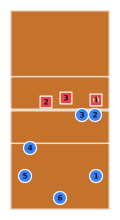
Perimeter defence
Volleyball · Defence · 9 players
A two-player block on their outside hitter, the left-front player off the net for the sharp angle, and the back row on the edges of the court: right back on the line, left back cross-court and the middle back deep.
Read the setup
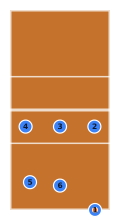
Serving team set-up
Volleyball · Formation · 6 players
Our serve, setter serving from behind the end line: the front three at the net ready to block and the back two in front of the server, every player in their rotation order so the overlap rule holds.
Read the setup
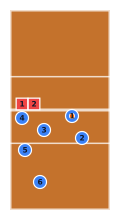
Hitter coverage
Volleyball · Attack · 8 players
Our outside hitter attacks from the left against a double block, and the other five close in behind them in a cup: the middle and libero tight, the back-row hitter deep, so a ball blocked straight down is still ours.
Read the setup
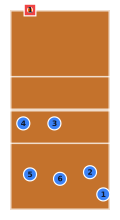
Serve receive, setter in 1
Volleyball · Set piece · 7 players
Three-passer serve receive with the setter in zone 1: both outside hitters and the libero share the court, the setter tucks in behind the right-side passer, and the opposite and middle wait at the net. Legal under the overlap rule at the moment of serve.
Read the setup
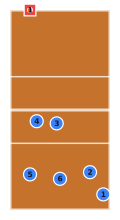
Serve receive, setter in 4
Volleyball · Set piece · 7 players
The setter starts front left at the net and slides right to set, while the outside hitters and libero take the serve and the opposite hides deep behind the right-side passer. Legal under the overlap rule at the moment of serve.
Read the setup
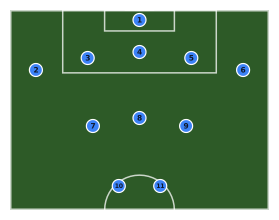
5-3-2 low block
Soccer · Defence · 11 players
A back five dropped onto the edge of the six-yard box with a midfield three in front and two strikers held back for the counter. What you set up when you are protecting a lead.
Read the setup
Put the Rotation defence on a pitch
It opens with the shape already drawn. Move the players your team does differently, drag the runs, and send your squad a link that animates.
Open in PlaymakerPage updated · Volleyball play designer · All templates