Cover your hitter, every swing
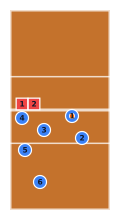
Volleyball · Attack · 6 of your players and 2 opponents
Our outside hitter attacks from the left against a double block, and the others close in behind them: the middle and the libero tight, the back-row hitter deeper, so a ball blocked straight back down is still ours.
Opens on a volleyball pitch with the shape already drawn. Free, no signup.
Who stands where
Hitter coverage is drawn at the moment of the attack. Our setter (1) has just set from the net, 5.6 m from the left sideline, and the front-row outside hitter (4) is attacking from the left, 1.1 m in and 0.7 m off the net, against two of their blockers at the net in front of them. Our numbers are the zones. The middle blocker (3), who ran a quick to hold their middle, has turned to cover 1.8 m off the net and 3.1 m across. The libero (5) is tight behind the hitter, 1.35 m in and 3.6 m back. The opposite (2) covers the inside, 6.5 m across and 2.5 m off the net, and the back-row outside hitter (6) is the deep layer, 2.7 m across and 6.5 m back.
Why a cup
A blocked ball comes back fast and short, usually within two or three metres of the hitter. Two or three players low and close catch most of it; one player deeper catches what is deflected high. That is the cup: a tight ring around the hitter with a second ring behind it. Teams that skip coverage give away every ball the block touches, and against a tall block that is a lot of points.
Coaching it
- Low and still. Coverage players should be set, low and stopped as the hitter swings. Moving feet cannot dig a block.
- Everybody covers. Only the hitter is excused. Draw each player's run into the cup and animate it at the speed of a real set.
- Then attack again. A covered ball is a free second chance; practise setting it straight back to the hitter.
Draw your own coverage for the middle and right side in the volleyball play designer, and share each one as a link.
Also known as
- attack coverage
- cover the hitter
- blocked ball
- outside attack
- cup coverage
Shapes to look at next
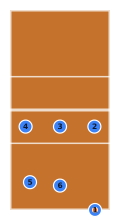
Serving team set-up
Volleyball · Formation · 6 players
Our serve, setter serving from behind the end line: the front three at the net ready to block and the back two in front of the server, every player in their rotation order so the overlap rule holds.
Read the setup
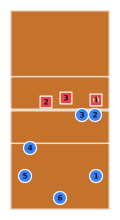
Perimeter defence
Volleyball · Defence · 9 players
A two-player block on their outside hitter, the left-front player off the net for the sharp angle, and the back row on the edges of the court: right back on the line, left back cross-court and the middle back deep.
Read the setup
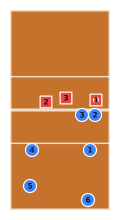
Rotation defence
Volleyball · Defence · 9 players
The same double block on their outside hitter, but the back row rotates towards the attack: the right back comes up behind the block for the tip, the middle back slides to the line and the left back covers the deep cross-court ball.
Read the setup
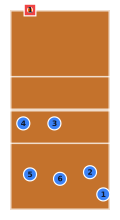
Serve receive, setter in 1
Volleyball · Set piece · 7 players
Three-passer serve receive with the setter in zone 1: both outside hitters and the libero share the court, the setter tucks in behind the right-side passer, and the opposite and middle wait at the net. Legal under the overlap rule at the moment of serve.
Read the setup
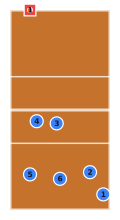
Serve receive, setter in 4
Volleyball · Set piece · 7 players
The setter starts front left at the net and slides right to set, while the outside hitters and libero take the serve and the opposite hides deep behind the right-side passer. Legal under the overlap rule at the moment of serve.
Read the setup
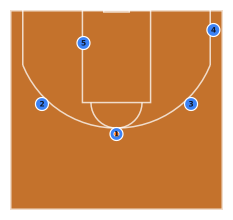
4-out 1-in
Basketball · Attack · 5 players
Four players spaced around the arc with one post on the left block. Keeps a genuine inside threat while leaving three-quarters of the floor open for perimeter action.
Read the setup
Put the Hitter coverage on a pitch
It opens with the shape already drawn. Move the players your team does differently, drag the runs, and send your squad a link that animates.
Open in PlaymakerPage updated · Volleyball play designer · All templates