Taking the restart without losing the ball
Rugby · Set piece · 15 of your players
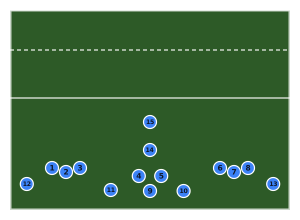
A kick-off is the one moment both teams are set and only one of them has practised. This is the receive drawn properly: eight forwards in position and two players covering the deep kick.
Opens on a rugby pitch with the shape already drawn. Free, no signup.
Where the fifteen stand at the restart
Eight forwards form the front of the receive: a pod of three on the left between about 10 m and 18 m across, a pod of three on the right between 52 m and 60 m, and a pair either side of the middle. All of them stand on or just behind the 10 m line, 10 m to 11.5 m back from halfway, which is the line that matters: the kick has to reach it, and Law 12 keeps the receiving side on or behind it until the ball is kicked, so nobody is allowed in front of it.
The halves are behind the pods: the scrum-half in the middle 4 m behind the line, ready to take the ball off the catcher, and the fly-half to the right and a little deeper, where the clearance kick comes from. The inside centre and the two wings fill in at the same depth, the wings on the touchlines. Then the two players who decide whether this goes well: the outside centre about 20 m off halfway, and the fullback deepest of all, standing just the far side of your own 22 for the long kick to the corner.
Choosing this receive
It is the balanced default: three lifting groups' worth of forwards for the contested ball, real cover for the drop-out length kick, and a full line of bodies on the 10 m line for a short kick that only just reaches it. Use it when you do not know what the opposition kicker does, or when they have shown you two different restarts already.
Adjust it once you do know. A team that hangs every kick on the 15 m line wants a pod shifted wide and the outside centre pushed up. A team that drills the long spiral to the corner wants the wing on that side dropped level with the fullback and one forward moved across to fill the gap.
Coaching points that survive contact
- Call the pod, then the catcher. Mark the receiving pod and the lifters and animate the ball into that spot, so the group taking the ball is decided before the whistle.
- First arriving forward has a job. Draw the run from the nearest pod to the catch, not to the ball — the difference is the ruck you either win or lose.
- Somebody talks to the fullback. Show the corridor between the wing and the fullback and put a name on it.
Pull this template up in the designer, move the pods to suit your kicker's opposite number, and animate the catch and the first carry as one sequence.
Also known as
- kick off
- restart
- receive
- pods
- back field
Shapes to look at next
Lineout (7-man)
Rugby · Set piece · 15 players
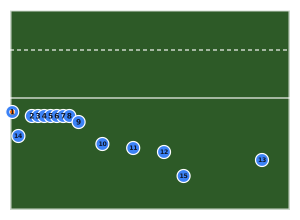
Seven forwards formed between the 5 m and 15 m lines with the hooker throwing from the touchline, the scrum-half receiving 2 m behind the tail inside the 15 m line, and the backs stacked behind at least 10 m back from the mark of touch (Law 18). Where the whole line stands is the bit coaches get wrong on a whiteboard, so it is drawn to the marks.
Read the setup
Attacking pods (1-3-3-1)
Rugby · Attack · 15 players
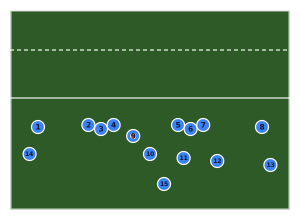
The forwards distributed across the field as one, three, three and one: a forward in each 15 m channel and two pods of three between them, with the halves, centres and back three in behind. Note the digits count players *across* the pitch, not lines of depth — 1-3-3-1 is a width map, which is exactly why it keeps a pod available on both sides of every ruck.
Read the setup
Defensive line (13 up, 2 back)
Rugby · Defence · 15 players
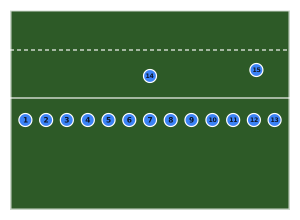
Thirteen in the front line at roughly 5 m spacing right across the pitch, with the fullback sweeping behind and the blindside winger holding the back field. The default defensive picture from a phase in the middle of the park.
Read the setup
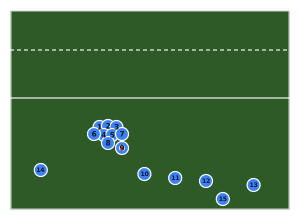
Attacking backline from a scrum
Rugby · Attack · 15 players
A full fifteen: eight bound into the scrum, the scrum-half at the base, and the backline fanned out to the open side roughly 8 m apart with the fly-half 10 m off the gain line. The blindside winger and fullback cover behind.
Read the setup
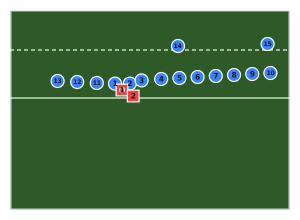
Ruck defence: pillar and post
Rugby · Defence · 17 players
Defending a ruck: two pillars either side of it, the post defender next out, then seven spread across the open side and three covering the blind, with the fullback and a winger sweeping. Gets the two jobs nobody volunteers for filled first.
Read the setup
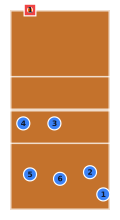
Serve receive, setter in 1
Volleyball · Set piece · 7 players
Three-passer serve receive with the setter in zone 1: both outside hitters and the libero share the court, the setter tucks in behind the right-side passer, and the opposite and middle wait at the net. Legal under the overlap rule at the moment of serve.
Read the setup
Put the Kick-off receive on a pitch
It opens with the shape already drawn. Move the players your team does differently, drag the runs, and send your squad a link that animates.
Open in PlaymakerPage updated · Rugby play designer · All templates