Free football play designer for grassroots coaches
Put your team on a proper pitch, drag the runs and passes, press play and send the move to the squad as a link. Free, nothing to install, and it works on the phone in your coat pocket on the touchline.
Free forever, no signup, nothing to install.
Football, as most of the world calls it
If you say pitch, boots and kit, and your week ends with a Sunday morning kick-off and a flask of tea on the touchline, this page is for you. Playmaker is a free football tactics board for grassroots coaches: put your players on a real pitch, drag the runs, add the passes, press play, and the move runs in front of you. Then send it to the squad as a link.
The app lists the sport as Soccer, because that is the word most of the coaches who search for a play designer type, and the soccer play designer page describes the same tool in American English. It is the same game, and on the eleven-a-side pitch the box, the six-yard box, the penalty spot and the centre circle are where the Laws of the Game put them, not where a marker pen happened to stop.
From 5-a-side to 11-a-side
Grassroots football is a ladder of small-sided games. Children start with a handful of players a side on a tiny pitch and step up through 5v5, 7v7 and 9v9 before the full eleven-a-side game. In England the FA has reworked that ladder from the 2026-27 season: 3v3 is now the entry format for under-7s, and the first eleven-a-side season moves to under-14s, so each small-sided format is played for longer than it used to be. Scotland, Wales, Ireland, Australia and New Zealand run their own versions, and leagues set their own ages, so check your league's handbook before the first fixture.
The designer draws three of those pitches, each to its own size rather than shrunk from the big one: 11v11, 9v9 and 7v7. Pick the format under Soccer and the markings change with it. There is no 5v5 or 3v3 pitch yet. For a five-a-side team, use the 7v7 pitch and take two players off; the shape you are teaching still reads, and the distances are closer to the truth than a full-size pitch would be.
Four shapes to start from
This page's shelf is four formations: one at seven a side, one at nine and two for the eleven-a-side game.
- 7v7 2-3-1: two at the back, three across the middle and a striker. The seven-a-side shape you will see most often on a Saturday morning.
- 9v9 3-3-2: a back three, a midfield three and a front two, so both strikers have someone to play off.
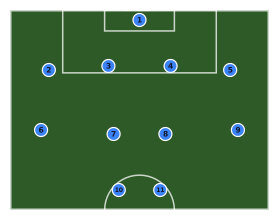
- 4-4-2: two banks of four and a pair up front. The shape most Sunday league sides can line up in without being told.
- 4-3-3: a back four, a midfield three and wingers holding the touchlines, which is the picture plenty of clubs bring their players up towards.
Each one opens in the designer with every player already standing in position. Move the two or three your side does differently, then draw the runs. To see every shape side by side, at every size, there is a page with every formation compared.
The throw-in further down this page is a real routine drawn in the designer, and it is the kind of thing a grassroots side gets twenty chances a match to use. Press play on it, then drag a player somewhere else and watch the move change.
The midweek session
Training is usually an hour on a floodlit third of a pitch, and too much of it goes on setting out cones and explaining what happens next. The soccer drills here are animated, so the players watch the rondo or the passing triangle move before they try it, and each one drops into a timed practice plan that keeps the session inside the hour you have booked. Print the plan and clip it to the bag of bibs.
Match day paperwork, done the night before
- The team sheet. The lineup builder puts a name on every position of your formation at 11v11, 9v9 or 7v7, lists everyone left over as a substitute, and prints on one page.
- Fair minutes. The rotation maker shares out the time for a 5v5, 7v7, 9v9 or 11v11 squad, so every child is within one period of everyone else and nobody sits out twice running. The names stay in your browser.
- Set pieces. The match-day sheet prints your corners, free kicks and throw-ins under their own headings on one page for the dugout, with a QR code that plays each routine on a phone.
Getting it to the squad
The link is the point. Paste it into the team's group chat and players and parents open it on their phones, press play and watch the move: no app, no login, no blurry photo of a whiteboard. A player who missed Thursday's session can watch the corner routine twice on the way to the ground, and turn up knowing where to stand.
Watch a play move
This is what your players open from the link you send them. Press play, drag a player, and press play again.
4 grassroots football templates, ready to draw on
Every one of these opens from the Formations button inside the designer. Load it, move the players your team does differently, and draw the runs from there.
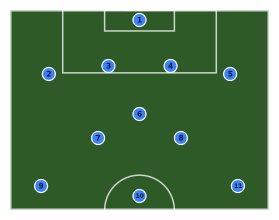
4-3-3
Formation
Back four, a single pivot with two eights ahead of them, and a front three holding the width. The wingers sit on the touchlines so the full backs have the space to overlap.
4-4-2
Formation
The classic two banks of four with a front pair. Drawn as a mid block defending the goal at the top: back four on the edge of the penalty area, midfield four across the middle third, strikers up on the halfway line.
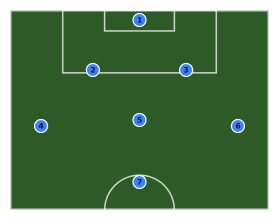
7v7 2-3-1
Formation
Seven a side: a keeper, two centre backs, a midfield three across the pitch and one striker. The most common 7v7 shape, because every player has a clear lane and nobody is left alone at the back.
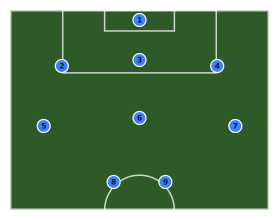
9v9 3-3-2
Formation
Nine a side: a back three, a midfield three across the pitch and two strikers. The balanced 9v9 shape, with a player in every lane of midfield and a strike partnership that learns to split and combine.
12 grassroots football drills, animated and ready for practice
Setup, coaching points and progressions for each, and one tap to add it to your session plan with its time.
- Rondo 4v1
- Pass and follow triangle
- Dribbling gates
- 1v1 to goal
- 2v2 pressure and cover
- Give-and-go to goal
- Lay-off and shoot
- Possession 3v3 plus 2
- Crossing and finishing
- Pressing the back four
- Transition game
- Playing out from the back
Grassroots football play designer: common questions
Is the football play designer free?
Yes. Drawing, animating and sharing plays is free with no limit, and you can start without an account. A free account keeps three saved plays; the paid plan raises that limit and removes the watermark from exports. The rotation maker and the practice plans are free with no account at all.
Why does the app call it soccer?
Most of the coaches who search for a play designer type soccer, so that is the name in the sport list. It is association football, drawn to the Laws of the Game, and everything on this page works the same whichever word you use.
Is there a 5-a-side pitch?
Not yet. The designer draws 11v11, 9v9 and 7v7 pitches, each to its own size. For five-a-side, draw on the 7v7 pitch and remove two players, and use the rotation maker, which does handle 5v5 squads, to share out the minutes.
Which formation suits a grassroots eleven-a-side team?
For most teams the 4-4-2 is the easiest to teach, because every player has a partner beside them and a clear line to hold. The 4-3-3 asks more of the midfield three, and it is the shape many clubs bring their young players up in. Start with the one your players already know.
Can I use it on my phone on the touchline?
Yes. It runs in the phone's browser, the pitch fills the screen and you can pinch to zoom, so there is nothing to install on yours or on the assistant manager's.
Can parents watch a play without an app?
Yes. Every play is a link that opens and animates on any phone, with no app and no account. Send it to the team group and a player who missed training can watch it before kick-off.
Call it soccer, or coach another sport?
The same play creation tool draws every one of them — and plenty of PE departments need two or three.
Draw your first grassroots football play now
It opens on the grassroots football pitch, it costs nothing, and your team can watch the play animate from a link.
Open the designerPage updated · What Playmaker is