Volleyball formations, every one on one page
Each one is drawn on the whole 18 x 9 m court, with the net and both attack lines, a line on when to use it and a page on how it works. The serve-time formations are legal under the overlap rule. Compare them here, then open the one you want and draw the runs your team makes from it.
Free, no account, nothing to install.
Serve receive and the serving team
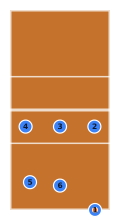
Serving team set-up
Formation · 6 players
Your own serve, with the setter serving. The front three wait 1.5 m off the net ready to block and the back two stand in front of the server, every player in rotation order.
Read the setup
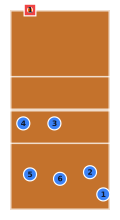
Serve receive, setter in 1
Set piece · 7 players
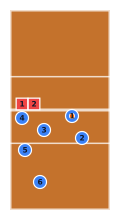
Receiving serve with your setter in zone 1, the back right corner. It is the first serve-receive formation most coaches teach: three passers, and the setter tucked in behind the right-side passer until the ball is served.
Read the setup
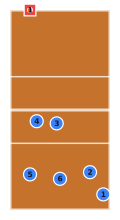
Serve receive, setter in 4
Set piece · 7 players
Receiving serve with your setter in the front row at zone 4, as far from the target as the front row allows. The outside hitters and the libero pass while the setter slides across.
Read the setup
How the serve-time formations compare
Who passes, where the setter starts and where they go once the ball is served, what the overlap rule asks of each rotation, and the catch. Every one is a starting point: the runs your team makes from it are yours to draw.
| Formation | Who passes | Where the setter starts | Where the setter goes | The overlap rule | The catch |
|---|---|---|---|---|---|
| Serving team set-up | Who passes: Nobody: it is your serve. The front three wait 1.5 m off the net to block and the back two stand 6.5 m and 6.8 m back | Where the setter starts: Serving from behind your end line, 7.65 m from the left sideline | Where the setter goes: Everyone may move once the ball is struck, from rotation order to their base positions | The overlap rule: Front three 4, 3, 2 from left to right, back two 5 before 6, each front-row player nearer the net than the one behind; only the server is exempt (FIVB rule 7.4) | The catch: The libero may not serve (FIVB rule 19.3.1.2), so when the libero's middle blocker rotates to zone 1 the middle comes back on to serve |
| Serve receive, setter in 1 | Who passes: Three: the back-row outside hitter on the left, 5.8 m back, the libero in the middle, 6.2 m back, and the front-row outside hitter on the right, 5.6 m from the net | Where the setter starts: Zone 1, behind the right-side passer: 8.4 m from the left sideline and 7.6 m back from the net | Where the setter goes: On the server's contact, and not before, to the target between zones 2 and 3 | The overlap rule: Zone 2 must be nearer the net than zone 1 behind it, so the setter starts behind the passer rather than beside them (FIVB rule 7.4) | The catch: The seams between the libero and each outside hitter, unless somebody owns them before the first drill |
| Serve receive, setter in 4 | Who passes: Three: the back-row outside hitter on the left, 1.8 m in, the libero in the middle, 6.2 m back, and the front-row outside hitter dropped back on the right, 5.6 m from the net | Where the setter starts: Zone 4, front left: 2.4 m in from the left sideline and a metre off the net | Where the setter goes: A slide right on the serve's contact, to the target between zones 2 and 3 | The overlap rule: The front row must be 4, 3, 2 from left to right, so the setter stays left of the middle blocker, and the opposite in zone 1 hides deeper than the passer in zone 2 (FIVB rule 7.4) | The catch: With the setter in the front row only two hitters attack at the net, so the opposite's back-row attack is the third option |
Defence
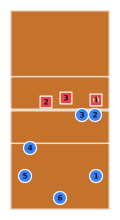
Perimeter defence
Defence · 9 players
Your base defence against their outside hitter. A double block takes the middle of the court and each digger owns an edge, which is why most club teams learn it first.
Read the setup
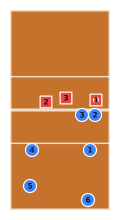
Rotation defence
Defence · 9 players
When their hitter tips and rolls shots over your block. Many coaches play perimeter as their base and call rotation against a hitter who is tipping.
Read the setup
How the defences compare
The same double block on their outside hitter, and the back row arranged two ways around it.
| Defence | Who takes the tip | Who is on the line | Who takes the angle | Where the hole is |
|---|---|---|---|---|
| Perimeter defence | Who takes the tip: Nobody close behind the block: the back row stays on the edges of the court | Who is on the line: The setter at right back, 7.7 m across and 5.9 m deep | Who takes the angle: The front-row outside hitter, 3.4 m off the net, for the sharp angle, and the libero at left back, 5.9 m deep, for the deep cross-court ball | Where the hole is: Short in the middle, behind the block: the middle back is 7.9 m deep, so a soft shot over the block lands in front of them |
| Rotation defence | Who takes the tip: The setter, up from right back to 3.6 m off the net and 7.2 m across, close behind the block | Who is on the line: The back-row outside hitter, rotated from the middle of the back court, 7 m across and 8.1 m deep | Who takes the angle: The front-row outside hitter, 3.6 m back, for the sharp angle, and the libero at left back, 6.8 m deep, for the hard cross-court ball | Where the hole is: The deep middle: a hard swing over the top has only the line digger and the left back deep |
Hitter coverage
What a volleyball formation is
A volleyball team does not choose where its six stand at the serve the way a soccer team chooses a shape. The rotation decides which zone each player is in, and the overlap rule (FIVB rule 7.4) decides how far they can stray from it: at the moment of serve each front-row player must be nearer the net than the back-row player behind them, and each row must keep its left-to-right order. So a serve-receive formation is the legal picture that gets three passers on the ball and the setter as close to the target as the rule allows, and it changes every time the team rotates.
Once the ball is struck, everyone may move. Defence and coverage are the shapes the team moves into for the rally: a double block and the diggers around it when the other side attacks, and a cup round your own hitter when you do. Every formation here numbers your players by their zone, so the numbers on the picture are the zones the rotation is called by.
Teaching them to your team
Start with serve receive with the setter in 1. Every pair in it is at least half a metre apart, so a player who stands a step out of place is still legal. Animate the setter's run so the team sees that the setter may leave the moment the server hits the ball, not before, and decide who takes the seams between the passers before the first drill.
The volleyball rotation maker draws the serve receive for all six rotations of a 5-1, a 6-2 or a 4-2 with your players' names, and prints them on one page for the bench. The volleyball serve receive guide explains what the overlap rule actually requires, and the volleyball 5-1 rotation guide follows the setter round all six rotations.
For defence, teach perimeter first, because each player owns an edge, then rotation as the call against a hitter who tips. Draw both in the same playbook and give each a word.
Volleyball formations: common questions
What is the overlap rule in volleyball?
At the moment of serve, each front-row player must be nearer the net than the back-row player behind them, and each row must be in rotation order from left to right: 4, 3, 2 at the front and 5, 6, 1 at the back. It is FIVB rule 7.4. The server is the only player it does not apply to. Once the ball is struck, everyone may move.
Which serve receive formation should beginners learn first?
Serve receive with the setter in 1. Both outside hitters and the libero pass, the middle blocker and the opposite wait at the net, and the setter starts in the back right corner behind the right-side passer. It is the first formation most volleyball coaches teach.
What is the difference between perimeter and rotation defence?
Both put up the same double block on their outside hitter. In perimeter defence the back row stays on the edges of the court, which leaves the middle open to a tip. In rotation defence the right back comes up behind the block for the tip and the middle back rotates to the line, which leaves the deep middle thinner if their hitter swings hard over the top.
How does hitter coverage work in volleyball?
A blocked ball usually comes back within two or three metres of the hitter, so two or three players close in low around them and one stays deeper for the ball deflected high. That is the cup. Everybody covers except the hitter.
Can the libero serve?
Not under FIVB rules (rule 19.3.1.2): when the libero's middle blocker rotates into zone 1, the middle comes back on to serve. Some youth, school and college rule books let the libero serve in one rotation, so check your own federation's rules before you plan it.
Can I change a formation after I open it?
Yes. Every formation opens on the whole court as a starting picture. Drag any player to where your team really stands, draw the runs, press play to watch it move, and send your team the link. It is free and you do not need an account.
Draw your own formation
Open a volleyball court, place your six, draw the runs and the sets and press play. Free, and you do not need an account.
Open a volleyball courtPage updated · Volleyball play designer · All volleyball templates